Niv

Dive into the issue
Community
Opinion
Arts & Culture
Variety
Sign up for niv’s newsletter
Memories Without Borders: Growing Community for Hungarian Jews in Toronto
Gabor Levai and Csaba Kurti didn’t know they were Jewish until they were teenagers.
“It wasn’t uncommon for Jews growing up in Hungary to not know they were Jewish,” Levai said.
Born in Budapest, Levai was only told he was Jewish when he was a young teenager. He remembers his parents sat him down during a family lunch to tell him the truth regarding his religious background.
Near the end of high school, after the fall of communism, he had the opportunity to travel to Israel for a six-week program. The experience changed his life. He reconnected with his Jewish roots and when he returned home he attended Jewish clubs and became president of the Hungarian branch of the Union of Jewish Students (which is similar to Hillel).
Kurti also didn’t know he was Jewish until he was 12, and his parents even chose the name, Csaba, as it was a “pure Hungarian name” with no Jewish affiliation, he said.
His parents “tried to hide everything” due to rampant antisemitism. When Kurti’s mom shared the “family secret” swearing him to not tell any friends or neighbours, Kurti said he didn’t even know what the Holocaust was, let alone Judaism.
“It was not a topic that was taught in the communist era, it was not in the curriculum,” he said.
Once the communist regime fell, Kurti’s parents went back to synagogue in the early 1990s. Around this time, he began to gather other young Jews to come together for Hanukkah parties and other events, feeling an inherent and deep connection with Judaism.
Levai said his and Kurti’s paths crossed in Hungary.
Kurti together with his brother, formed the JMPoint Foundation (Jewish Meeting Point), a community platform that included matchmaking, heritage preservation, formal and non-formal education, family camps, and cultural programs, bringing thousands of Hungarian-speaking Jews together from around the world. Levai led the Hungarian Jewish Youth Association (UJS - Union of Jewish Students) and volunteered extensively.
Since 1999, Levai has been an entrepreneur with a focus on communication, media, and business consulting. Kurti has worked as an IT project manager and business analyst and served as the strategic director of the Autonomous Orthodox Jewish Community of Hungary.
“In both cases, community work was something we did out of love—while maintaining full-time careers,” Levai said. It was this strong history of community building that followed them when they immigrated to Canada.
When they both met in Toronto, almost 10 years ago, the same question came to both of them: “Where is the Hungarian-Jewish community here—and if it doesn’t exist, why don’t we build it?”
Levai and Kurti found that Toronto was home to many Hungarian Jews, but people often gathered in small groups; there was no central meeting hub or communal space to come together.
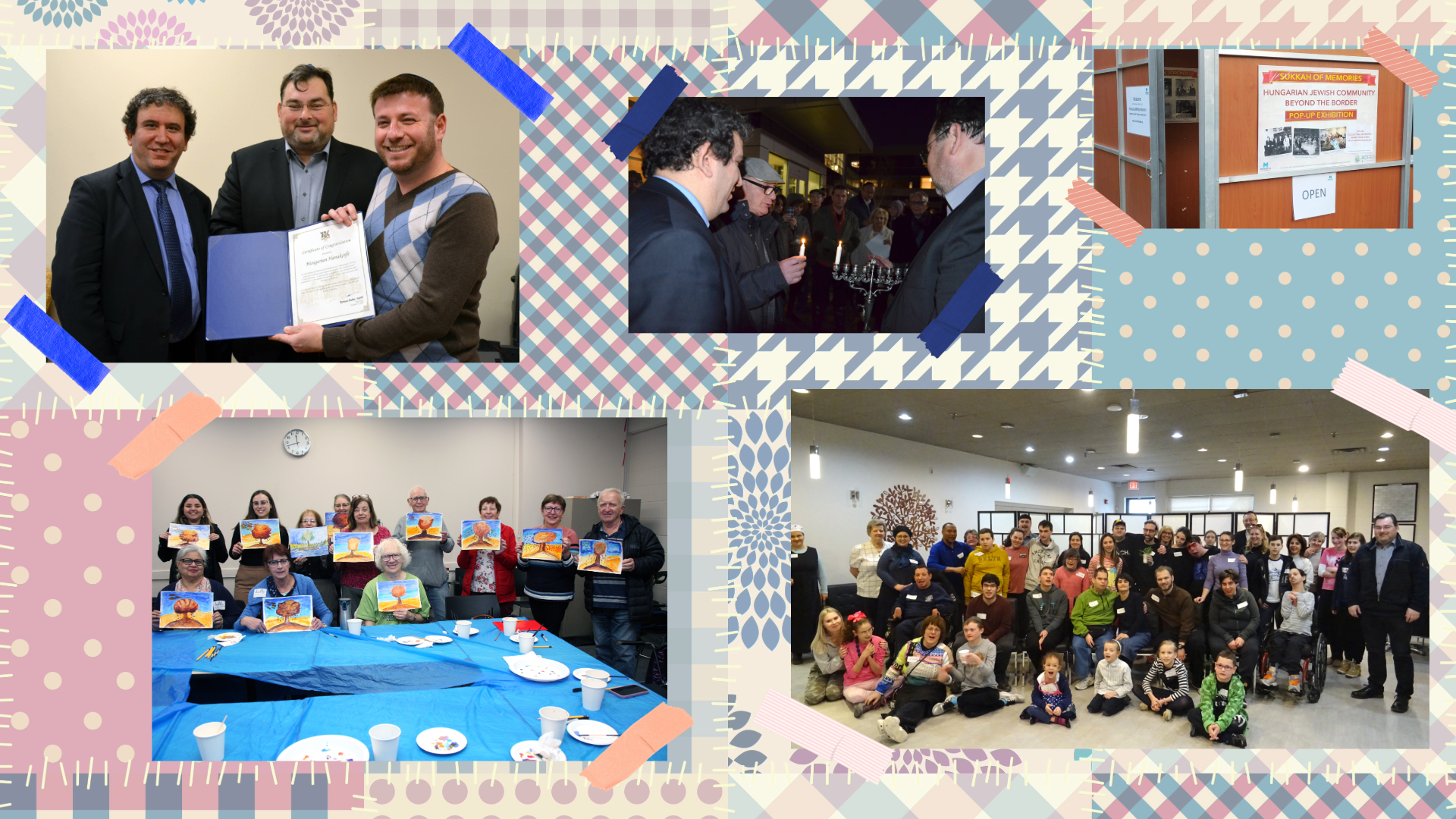
They wanted to change that and in 2019 they launched Memories Without Borders, an organization for the Hungarian Jewish diaspora.
The organization has put on numerous events over the years which include Shabbat dinners for friends and families to gather, excursions and cultural trips around the city, but one of their proudest accomplishments is The Senior Academy, which gives workshops, lectures, and interactive activities to Jewish and non-Jewish seniors.
During the pandemic, Kurti and Levai realized how isolated seniors had become so they began donating food weekly for three months to seniors in need, and realized that providing resources and connection to this demographic was of high-importance for their organization.
They also recently launched a rental program for equipment such as cameras, tripods, professional lighting, microphones and more to provide professional tools for community programs, educational purposes and content creation for those who may have difficulty accessing high-end equipment.
Levai and Kurti are also working on grants and sponsors to find their own physical space to work out of, right now, they rent from the Prosserman JCC, but they would like a central place to work from and put on events.
While they work towards that goal, their work is ever-meaningful, as they help foster community and engage Hungarian Jews in the city. Their upcoming Hanukkah party on December 16, will be one of their biggest events yet, with more than 100 tickets sold.
“It's very heartwarming, it feels really good (to bring people together),” Levai said. ”You know, it's still exciting when we meet a fellow Hungarian. For example, today we met someone and they said, ‘Oh, I have Hungarian roots too.’ They don’t speak the language but their mother and grandmother do. So we just invited them to the Hanukkah party. That’s when we see, this is working. We’ve built something and we can see it grow.”

Adventuring Together: A Mother and Daughter Find Life-Changing Experiences in the Wilderness
Bonnie Chandler, a dentist from Toronto, loves the outdoors. It started from when she was a kid going camping with her dad. She later spent three seasons in Algonquin Park doing fisheries research, where she spent off-hours canoeing and kayaking.
Her adventures in the wild never stopped and she has instilled that same intrepid spirit in the next generation. Just as Bonnie’s father took her on nature trips, she takes her children on wilderness expeditions.
I had the pleasure of speaking to Bonnie and her daughter Yael, a product designer, about their most-recent trip to the Nahanni River, known by the Dehcho Dene people as Nahʔą Dehé, in the Northwest Territories.
From August 1 until August 14, Bonnie and Yael lived alongside the river and its surrounding land, topped with spindly trees. They went with Black Feather, a company that has been taking participants on “self-propelled trips by foot, canoe, sea kayak, ski and raft in unique wilderness locales” for over 50 years.
However, it is not their first trek through the North. The mother-daughter duo, who I am campaigning to go on The Amazing Race Canada, have paddled through the Wind River in the Yukon, the Kiel River in the Northwest Territories, and now the Nahanni River. But it never gets old. From bear sightings to fishing to witnessing breath-taking canyons, nature’s beauty remains striking. And it is their time together, amongst the unbelievable landscapes that leads to a strengthening of connection between family, community, and the land we dwell on.
Some of us will never go on wilderness excursions, our adventures will lead us elsewhere, but reading can transport you anywhere. Next stop: Nahanni River.
What does it mean for you both, as mother and daughter, to take these trips together?
Bonnie: I’m very blessed that she would come with me three times. And we get along great. We help each other out. But Yael is stronger than me right now. She’s a real bear.
Yael: This trip we were with two sets of couples, and then two single people who came on their own. I think all of them have kids, and they all said, I wish that my daughter, my son, would come with me. When we went on our first trip, and I was telling some of my friends, they were shocked that I was willing to spend two weeks sharing a tent with my mom.
Bonnie: I was the oldest one on this trip and Yael was the youngest by about 30 years. On other trips there wasn’t such a difference, but I have to say, everyone loved Yael. I find Yael extremely happy on these trips. You can’t wipe that smile off her face.
How do you accommodate your Jewish practice on these trips? Bonnie: We keep kosher, so we ate a vegetarian diet on the trip.
Yael: We explained to people what kashrut means, why we follow it. One of our guides this year, Charlie, his dad was a Black Feather guide before him. He said that his dad once took a group of Orthodox Jews on a private trip and all the guides made sure everything was kosher. They brought new pots and pans and brought kosher meat. They’re really accommodating. The company is fantastic.
How are the meals prepared?
The guides know how to cook. When you go on a canoe trip on your own, you’re packing dehydrated food and oatmeal, it’s not super inspiring. They take no dried food. It’s all fresh and they plan their meals so it lasts until day 12 and day 14 without a refrigerator. They make cinnamon buns from scratch. You see the guides the night before making the dough, and in the morning, rolling up the cinnamon buns. Each trip we’ve been on, the guides prefer different levels of involvement in cooking from the participants. On our second trip, they were happy for everyone to help. Everyone was always in the “kitchen,” which is two overturned canoes in an L shape, cutting stuff up and stirring food over the fire. You’re never hungry.
Bonnie: We always help with the dishes. Everybody’s happy to chip in.
What did your Judaism bring to this experience?
Bonnie: This year we had a woman on our trip who was born Jewish but hasn’t practiced Judaism in a long time. One night, she came up to us after dinner and she said, It’s my dad's yahrzeit, I usually light a candle. And so our guide gave us a candle. Yael said Kaddish, and she repeated after me. She didn’t know the words. I don't know if she’s ever said it before, it was special.
Over the course of your travels, what have you learned from one another?
Yael: My mom has a lot of experience doing trips like this and adventuring and being in nature. I’m always learning about different trees and plants and flowers from her, and even just how she puts up her tent or how she takes it down.
I'm sure that it can get hard sometimes when you’re out there.
Yael: There are challenges we had on this trip. The weather was great and not too cold, because it can get cold up there. But there was one day when it poured for 30 hours straight. We were cold and wet, and paddling in the rain, and then setting up our tent in the rain. And tents are not waterproof. The guides were making a fire with wet wood. But it’s all part of the experience, and it’s kind of character building and team building.
Bonnie: I think more people should do it. It's pretty expensive. That’s the one thing. I think that's why people who go on the trip are a little older. But it can be really life changing.
How so?
Yael: You have to be self-reliant, but as a group. And turning off your phone and shoving it at the bottom of your pack and not seeing it for two weeks is an amazing feeling. You have tons of questions on these trips like, “What tree is that?” “What if I can’t start a fire?” Needing to figure stuff out on your own is an experience we don’t always have today. When you’re on a trip like this, you have 14 days and you’re starting at point A and you need to get to point B. But in between that time, the guides and the group are constantly making decisions about how far we can go based on the group’s energy or the weather. Those are the things that matter. Coming back from that and going back to work in tech, a high-pressure environment, I just had this feeling that the deadlines at work are based on nothing. It feels so artificial, in a sense, after being in nature and seeing what really matters and where we should be putting our effort.

Quilting Through Life: The NCJWC's The Toronto Jewish Quilting Project Deliver Warmth and Comfort to Cancer Patients
If your air conditioner is broken on a Wednesday between 1:30 p.m. and 3:30 p.m., “the best place to be,” joked Eva Karpati, is at the National Council of Jewish Women Canada’s (NCJWC) office in North York, Toronto. For those two hours, while you may be cooling off, your heart will be warmed with community as you and a bevy of women, quilt, perhaps gossip, and hear at least one woman brag about a grandchild.
The Toronto Jewish Quilting Project first met 21 years ago on a blistering cold December night at Barbara Frum Library. Any season, it seems, is one fit for quilting when you’re surrounded by new and old friends creating for good. That evening, 25 women gathered to make quilts for those touched by cancer. The Angel Quilts, as they would go on to be called, have offered comfort to over 500 people.
Prior to this first meeting, Karpati, the TJQP’s founder, had, unfortunately, experienced her own cancer journey. Diagnosed November 2001, she went through a year of chemotherapy and radiation. At the end of her treatment, as a form of therapy, she started taking quilting lessons at Wellspring. Making tangible art proved to be a form of meditation. In addition to learning how to quilt, Karpati wanted to gift one to a young Jewish woman in her support group. At the time, there wasn’t a resource in Toronto that donated quilts to those affected by cancer, and so she had to request one from Ottawa.
Three years after that fateful December night, and many other days and nights when Karpati hauled mounds of fabrics in and out of her car, her initiative was adopted by the NCJWC Toronto chapter.
And when I met Karpati in that aired condition office on July 2, along with the other women in the group, the same fire that must have helped fuel those hauls, was effervescent. She bustled around the room we were in. You do not need to know how to sew, you do not need to be Jewish, nor do you need to be a survivor of cancer to attend, she told me. You just, I realized, have to want to be there. With one quilter remarking: “Everybody is from everywhere. Everyone has their own history. No one judges, or snips.”

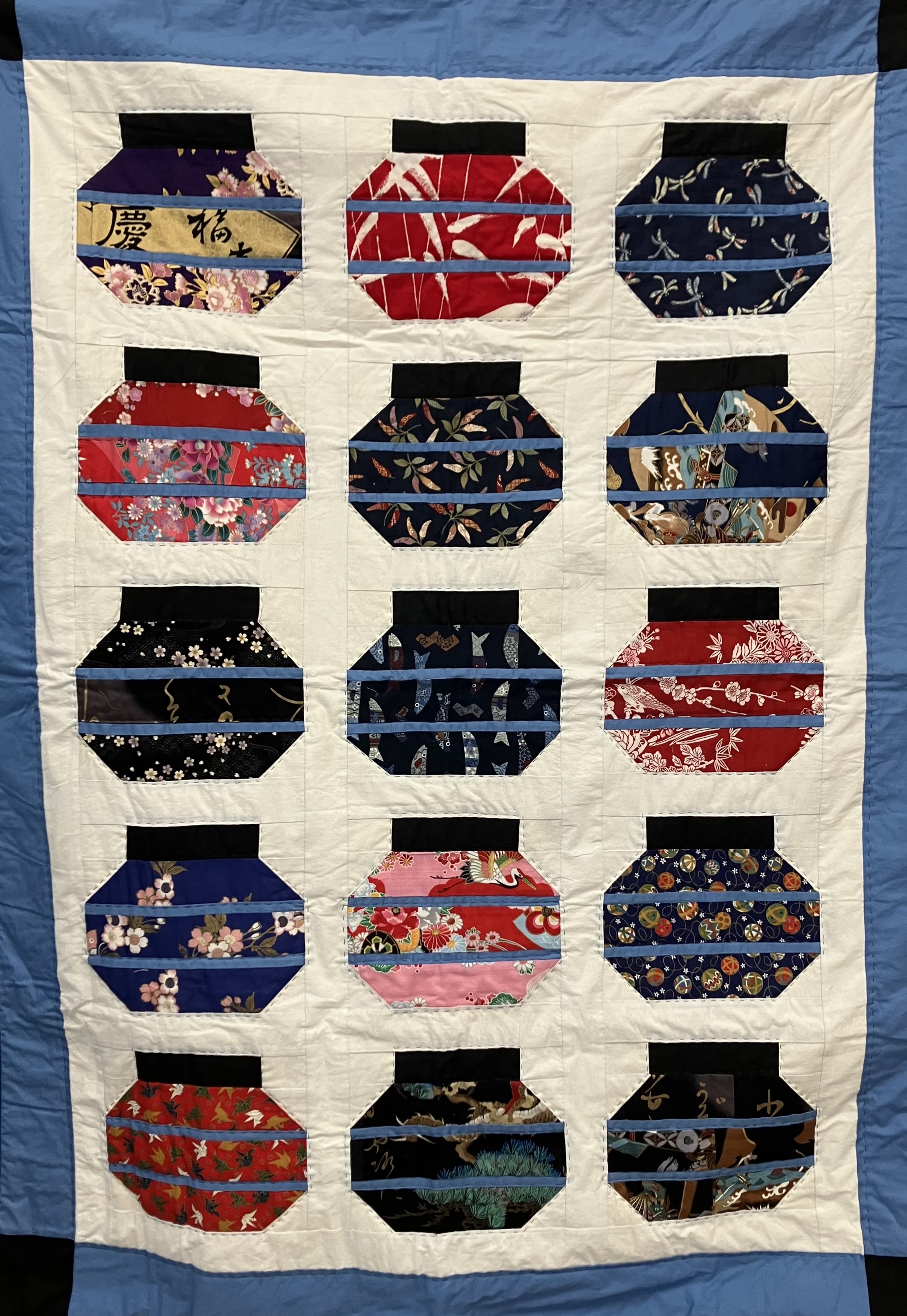
As Karpati moved around the large room, where there were more than a dozen women gathered, she lit up when speaking about their work and the community she helped build. The women, in most cases, do not know who will be the one to find warmth in the fabric their hands have sewed. The process is by referral, someone who knows someone will request the quilt but the organization does not give the recipient the quilt directly. Instead, they’ll often give it to the person who initially contacted them. Though most are in the city, recipients can be of any faith or gender. It is simply for someone going through treatment.
It takes around two months to finish a quilt, and different quilts are being made at the same time. I asked the terrible question to one quilter on if she had a favourite quilt. To which she responded: “They’re all special. In the end they’re all beautiful.”
However, there are favourite stories.
Karpati’s is about the first quilt the TJQP made and donated. It was to her friend, and now fellow quilter, Susie.
In 2004, Susie got leukemia and was living in London, Ontario. She had known Karpati when they had worked at the JCC in Toronto as fitness instructors but had lost touch over the years. When Susie moved back to Toronto to recover at her sister’s, Susie shared with me, a knock came at the door and it was Karpati with a “beautiful quilt. I loved it.”
When Susie moved into her own place, she decided to hang up her quilt on the wall. “We want all our quilts to become,” Karpati remarked, “a memento of a journey that the recipient has gone on” and now, Susie’s quilt is “a piece of art.” It has been five years since Susie started quilting with the other women, and making pieces of art for folks who are in the same place she once was. “I still don’t know everybody’s names and I’m terrible at sewing,” but, Susie adds, “It’s nice to know I’m part of this too. After having gotten one myself, now I can give back.”

In addition to quilters offering their time, the TJQP has received donations from Fabricland and even from an acquaintance of longtime quilter Mary’s daughter’s Sunday school teacher’s husband, Bob.
Mary had a lovely Jewish friend, Sheila Fruitman, who she played bridge with. Fruitman would always talk about attending Karpati’s quilting sessions. One day, Mary asked if she could come with, and for the past 10 years she hasn’t stopped. Which is where Bob comes in. His wife, Janet, was a talented quilter and after she passed away, Bob offered them her materials. There was one container of beautiful quilting blocks that had been machine sewn. When Aliza, another quilter, saw these blocks she took them home and put them together to make a beautiful quilt top. “Whoever has the quilt” said Mary, “has something started by a woman who passed away. It’s a tribute to this person. Bob was so pleased to see this quilt that was in honour of his wife.”
In faith-based charitable organizations, it is assumed everyone prays to the same God, which I gather is why Mary, when I first approached her, told me she wasn’t Jewish. But isn’t it wonderful to see that within the Jewish community we still gather with people from different religions, and in some respects feel like family to one another. In fact, that’s how Mary describes it: “it’s like a family.” And family comes in all shapes, sizes, and practices.

From floral quilts, to a Wizard of Oz quilt, to a heart quilt, to a lantern quilt, to a jewel quilt, to the layers of blocks and tops that have been hand and machine-sewed, each stitch was made with purpose over tea and sweets and laughter, and likely tears. When I visited the NCJWC office that day, a mix-and-match quilt was being crafted. “It represents the group when we all come together. It’s not a set pattern.” But, I myself will add, that’s what makes it work.
Eva Karpati, Susie, Mary, and all the other women I spoke to that day made me feel instantly welcomed. If you have the opportunity to quilt your way through life, or just through two hours of a Wednesday of your life, with friends who feel like family in an air-conditioned room, giving the reprieve of comfort to those in need—well, The Toronto Jewish Quilting Project truly does sound like one of the best places you can be.

NCJWC-Toronto Delivers Sustenance This Passover Season
Since 1983 the National Council for Jewish Women of Canada, Toronto (NCJWC-Toronto) has tried to ensure that the vulnerable in our community can celebrate Passover with a food-filled Seder. With help from social agencies, food banks, volunteers, students, and donors, their Passover Food Drive has served over 75,000 food boxes to residents in the Greater Toronto Area.
The NCJWC-Toronto is a storied organization with 128 years of service and counting. Their programs support Jewish women diagnosed with cancer, victims of human trafficking, and, as established through their food drive, food insecurity.
This year marks the first time the organization will be partnering with Reena for their Passover initiative. Robin Gofine, NCJWC-Toronto’s executive director, noted that the partnership came out of necessity because they needed more space to accommodate boxes due to high demand. Additionally, Reena’s ethos aligns with theirs.
Reena “provides housing, programs and employment services for individuals with Autism and other developmental disabilities, mental health challenges, and other diverse health needs.” They, like NCJWC-Toronto, want to “get the job done,” Gofine emphasized, “and serve the vulnerable.”
The contents of the boxes are nutritionally balanced and selected with thought and care to provide Seder essentials: matzah, matzah meal, candles, oil, jam, chicken soup mix, gefilte fish, and something sweet.
Preparations for this year’s drive began in November, and the packing of boxes lasted from March 23 until April 1. Gofine is the only member of staff. The whole drive, she shared with me over Zoom, is organized and implemented by volunteers. Volunteers supervise the shipments, pack boxes, and will be the ones delivering the boxes on April 6.
I spoke with Gofine and NCJWC-Toronto’s chair, Shelly Freedman, to listen to their remarks on community togetherness during this time of year, the power of volunteerism, and what the future of the NCJWC-Toronto holds.
How have things changed because of and since the pandemic for the food drive?
SF: Before COVID-19, on the day we would do deliveries out of our old building there would be cars lined up around the street just waiting to get boxes and a school bus full of kids who were going to help. But after COVID-19, a lot of those people are much older, and a lot of people who had been volunteering for years are now at an age where the boxes are heavy. They do weigh about 23 pounds.
RG: Last year we needed more help with deliveries, and so I approached someone with a large following on a WhatsApp group. I told him we needed help and 50 cars showed up and they finished the job.
SF: All these people were younger. They were 40 year olds and they brought their kids because they were tuned into this guy.
RG: Even though this is a legacy organization that’s been around for 128 years and the Passover food drive is 42 years old, we are evolving as an organization, and we are learning new methodologies and taking advantage of the benefits of social media. We want to encourage the young people and newcomers in our community to feel a sense of responsibility for caring for other Jewish people, which I think is always important, and it's particularly important at this time.
With the cost of food and living increasing, has the amount of boxes you deliver increased too?
SF: We were doing about 1,800 boxes before COVID-19. Last year, after the war, we got a lot of people, a lot of Israelis, on our list who’d come to avoid the war and JIAS sent them to us.
How many boxes do you estimate will be delivered this year?
RG: Around 2,300, but people always come up out of the woodwork. Normally, the bulk of the referrals come from social service agencies, but when people call us and say, I need help, we ask them to have an email sent to us by a rabbi, somebody who knows their situation, or a social service organization that they may be affiliated with.
Reena joins you as a partner this year. What are some of the ways they will be involved in the process?
RG: We encourage volunteers to write a personal note and include it in the box, so that when people receive the box, they also get a card with a note.
SF: A lot of times the kids do that, and they just sign their name in their scribble and then the recipients put them on their fridge. This year, we gave a lot of the cards to Reena people, and they’re colouring them in for us. They’re also helping us make candles. So because the holiday spans a week and there’s all the Yom Tovim, we supply them with little tea lights in a bag with a bracha to light the candles for all the nights. We have two or three student groups, a group of volunteers from the council, our L'Chaim group, and we also have Reena doing some as well. They're also going to be doing some packing and helping us with setup and other things. There's a lot of participation by Reena people, which is new for us, but we're looking forward to it.
RG: Moishe House is also a new partner this year, and they’re also going to be helping us out with the packing. They’re coming out with a large group. It really is a true community-wide endeavour.
Have there been surprising moments over the years that have demonstrated to you the impact of this initiative?
RG: Three years ago, my first year here, I got a request to deliver a box in the Jane-Finch corridor. It was in a hostel, and it was for a young woman who called us and said, My parents have kicked me out of our house, and I was found on the street, and now I'm in this hostel. I don't have any food for Passover. Can you help me? So we brought her a box of food. The girl was probably in her teens and she had no support, but somehow she was put in touch with us.
What do you envision you’ll be needing, whether it’s for the NCJWC-Toronto or just for the Passover Food Drive, in the years to come.
SF: There will always be the need for Passover food. I can’t see something like that changing. As far as what the organization needs, like any organization today, it needs new, fresh ideas and fresh blood and younger people willing to take time to do it, which I understand, in their lives and in our lives, is difficult. There’s been a bit of a resurgence of retired women, and they have fantastic experience in the workforce, but we are trying to initiate younger groups and to make them aware of us.
RG: Ensuring we pass this project to the next generation and that the next generation will take responsibility to make sure the needs of our community continue to be looked after. Ongoing financial support, because this project cannot happen without that. I’m also interested in looking at, more broadly, the issue of food insecurity for this organization and what are the opportunities beyond Passover that are effective in addressing food insecurity. What else can we do in this area to address community needs? And how can we do that, and what’s worked here that we can apply to address needs and fill gaps in community beyond Passover.
What does it mean to you to be doing work like this at the NCJWC-Toronto and to give back to the community during Passover?
SF: Different volunteers over the years have been doing this. A lot of people in council are very familiar with this project and they come back every year and help out. For me, it’s a real sense of satisfaction that all these people can share in the Seders, can all have the opportunity for the mitzvot, and that the recipients’ Passover isn't limited by their financial situation because they’ll have everything they need for a Seder.
RG: When I sit down at the Seder and I read, All who are hungry, let them come and eat. All who are in need, let them come celebrate Passover with us, I have this moment of: look what we just did. So for me, it breathes real meaning into the purpose of the holiday. And also, as the professional lead in a Jewish women’s organization, I'm in awe of the power of these women, this legacy of women from Shelly backward, who take on this responsibility with grace and passion, and don’t get ruffled. Every challenge that comes their way they get the job done. As a Jewish woman, I feel privileged as a professional to have the opportunity to support their work.
SF: This organization has been built by wonderful, intelligent, resourceful women for decades.
This interview has been edited for length and clarity.

ARTS & KVETCH: Spring Ahead
Happy spring, Niv readers! With Passover coming up next weekend and warmer weather approaching, hopefully it’s the beginning of a season of positivity for all of you. Let’s get into the upcoming events in Toronto over the next few months.
FILM
Toronto Jewish Film Festival
The forthcoming festival will take place from Thursday, June 5 to Sunday, June 15, 2025, so stay tuned for announcements about this year’s programming, which should come in early May. Snag your Flex Pass before May 11 to get a discount.
In the meantime, you can attend National Canadian Film Day on Wednesday, April 16. Film festivals and organizations participate in this event annually, screening films for free across the country. The Toronto Jewish Film Festival is screening the newly restored classic Sunshine at 6:30 p.m. at Cineplex Cinemas Varsity and VIP. Please note that while tickets are free, registration is required. Oscar-winning director István Szabó’s Sunshine takes place in the mid-19th century onwards, telling the story of three generations of the Jewish-Hungarian Sonnenschein family. Ralph Fiennes plays the protagonist, supported by a large ensemble cast with Rachel Weisz, John Neville, and Jennifer Ehle. Beware: this is a three-hour epic.
Hollywood Exiles
If you’re anything like me and have a love for film soundtracks, then this event will likely be of interest. Miklós Rózsa was a Jewish Hungarian-American composer who moved from Hungary to Paris to London and finally to Hollywood amidst the Second World War, eventually finding a path for himself scoring movies. Koffler Arts is presenting Hollywood Exiles with the ARC ensemble (Artists of The Royal Conservatory), who will perform his music at Mazzoleni Hall, at TELUS Centre for Performance and Learning (The Royal Conservatory). Purchase tickets for $40 here.
The Miles Nadal JCC is also hosting a screening of Alain Resnais’s 1977 film Providence, which Rózsa scored. Toronto Metropolitan University professor Dr. Owen Lyons (School of Image Arts) will introduce Rózsa and the film. Register for tickets here.
JEWISH HISTORY & LEARNING
Threads of Spadina: Our Interwoven Stories
Toronto has a rich Jewish past and Spadina is perhaps the best street to explore this history. On Sunday April 27, you can explore the neighbourhood’s rich tapestry of characters and locations. This morning walk will reveal a whole new world to you, guiding you around a neighbourhood where seamstresses, tailors, bagel shops and pushcarts used to dominate; allowing a peek back in time to when Spadina was the heart of Toronto’s Jewish community.
Judaism 101
Feel like you need a refresher on your Judaism? This class runs on Thursdays from May 1 until June 19, and is welcome to Jews and non-Jews. The eight-week course takes place on Zoom and will cover everything from Shabbat to synagogue to spirituality. If you have any questions, please contact LaurenS@mnjcc.org.
Lishma
Lishma is a community of learners mostly in their 20s and 30s who enjoy delving into Jewish wisdom and scholarship. Regardless of your knowledge level or background, you are welcome to join. Each semester has three classes running side by side, and this spring, one of the lecture series is titled Riding the Chariot: Psychedelic Jewish Mysticism and the Fringes of Consciousness, which will run on Wednesdays from April 23 to May 28, 7–9 p.m. The name alone is enough to intrigue me!
Holocaust Remembrance
On now at the Royal Ontario Museum (ROM) is AUSCHWITZ. Not long ago. Not far away. The exhibit costs $13 in addition to the ROM entry fee (though it is free for ROM members). Use the code MNJCC at checkout for 15 percent off your ticket fee.
This exhibit arrived just prior to the 80th anniversary of the liberation of Auschwitz (January 27, 2025) and it will leave Toronto in September 2025. Incredibly comprehensive, featuring survivor testimonials, historical documentation, first-hand accounts by emancipating forces, and more than 500 original objects, this exhibit contains distressing content and is not recommended for children under the age of 12. However, care has been taken to ensure that there are no gratuitous depictions of violence.
Alternatively, you can gain a deeper understanding with a private guided tour in partnership with the Toronto Holocaust Museum (THM).
THM is also hosting a community commemoration on April 23 with a number of local Jewish organizations. This will mark Yom Hashoah V’Hagvurah, the eve of Holocaust Remembrance Day. As part of the commemoration, THM will look back on the 80 years that have passed since the Holocaust, contemplating how survivors and their descendants honour the memories of the families who were taken.
Jewish& is also partnering with THM for a special event honouring interfaith, multi-faith, and multi-heritage individuals and families on May 7. Rabbi Denise Handlarski (Toronto Rabbi and author of The A–Z of Intermarriage) will guide a discussion on history that honours different perspectives.This will be a welcoming and open space for individuals in interfaith relationships, assisting Jewish individuals grappling with painful topics on their own, and their partners, who may be unsure of how to broach these issues.
MUSIC
This annual event is coming up quickly! From May 18 until May 25, you will be able to hear Klezmer, Cantorial, Israeli, Sephardic, Yiddish, Holocaust, Middle Eastern, Jewish Broadway, Jewish Opera, Jewish Classical, Jewish Jazz, Jewish Country, and more. I didn’t even know some of those genres, like Jewish Country music, existed; but I’m certainly interested. This year marks 13 years of the festival—their Bar Mitzvah Year! Program guides come out after Passover, so join the mailing list to make sure you don’t miss them. If you want to get a sense of the festival, you can check out last year’s program here.
COMEDY AND LIVE EVENTS
From June 7 until June 15, the Harold Green Jewish Theatre is presenting Estelle Singerman: Summer Night, With Unicorn. If the title sounds mysterious and mystical, that’s because it is; this play is about the relationship between an eccentric older woman (Estelle) and an emotionally absent middle-aged man (Warren). Because she is so reclusive, Estelle is worried that no one will say Kaddish for her when she passes, and has thus decided that Warren will take on the job. Surrealist, with magical realism reminiscent of Hasidic folktales, this play features a journey of life and death, faith and peace. Written by David Rush and directed by David Ferry, you can purchase tickets here.
Have you ever heard a better title for a comedy series than Laugh my Tuchus Off? These shows will spotlight some of the comedy circuit’s rising Jewish stars, as well as a number of veterans in the industry. Curb your Enthusiasm actor Iris Bahr, Canadian legend Colin Mochrie, and Tik Tok viral sensations Eitan Levine and Raanan Hershberg are just a few of the comedians you can see.
SPOTLIGHT ON: NIV COFOUNDER ORLY ZEBAK
Most importantly is a Friday evening featuring one of your favourite Niv cofounders, Orly Zebak! Orly has been taking part in stand-up comedy for the past few months, and on Friday, April 18 at Free Times Café, you can see her perform live. You can expect laughs, good vibes, and delicious food and drinks. The evening features some great comics from across Toronto, including headliner Monica Gross.
Orly did not sponsor this post.
AND LASTLY
I think this next event counts as Passover-adjacent because it has to do with cooking! And for an Arts & Kvetch sorely missing Passover content, that needs to count for something. The Prosserman JCC is presenting Eden Eats: An Exclusive Culinary Experience on May 12, where Eden Grinshpan will discuss Middle Eastern and Mediterranean-inspired meals. Be sure to check out her new cookbook Tahini Baby. It will be too late to put the dishes into practice for Passover, but there’s always next year’s High Holidays!
Koffler Arts’ current exhibition was created by Toronto-born and Brooklyn-based artist Elana Herzog and curated by artist Jessica Stockholder. The installation was made using wallpaper designed by the artist, with paint, textiles, and metal staples. These materials, gathered through years of collecting and thrifting, are reassembled and transformed through Herzog’s work. Herzog’s exhibition surveys her 35 year career, and reflects themes that interest her, including sustainability, history, tradition, individualism, and sensuality.
You can view the solo exhibition until Sunday, May 11.
If you are trying to figure out what day to catch the exhibition on, I recommend Sunday, April 27, as Kurdish-born multi-disciplinary artist Roda Medhat will be giving a gallery talk on the exhibition and Herzog’s career as a whole.
I feel as though I need to mention pickleball at least once in every article I write, so here is the requisite acknowledgement. If you still haven’t managed to pick up the sport, despite its popularity, perhaps you would like to join the MNJCC’s Intro to Pickleball Clinic. This beginners workshop runs every couple of weeks, and will help you with skill building, basic rules, and scoring. You’ll also get to practice in friendly matches, and instructors will show you fundamental techniques and footwork. If you get hooked on the sport (as everyone else has, apparently), you can also take part in the MNJCC’s Intro to Pickleball Course, as the next one starts on May 10.
Happy Passover to all!

Nobody Wants This Improves its Portrayal of Jewish Women
October brought us the long-anticipated second season of Netflix’s hit show Nobody Wants This. Last year, I wrote about my disappointment in the program’s portrayal of Jewish women. I wondered if season two would fare any better—and to my surprise, it did.
The show’s creator, Erin Foster, loosely based the series on her own life. The show explores the interfaith relationship of podcast host Joanne (Kristen Bell) and Rabbi Noah (Adam Brody). In season one, the non-Jewish women were portrayed as fun and carefree, while the Jewish women were nit-picky and irritating. That stereotypical portrayal received significant backlash, and it seems Foster heard the criticism loud and clear.
The character of Esther (Jackie Tohn) who was happily-unhappily married to Rabbi Noah’s brother, Sasha (Timothy Simons), undergoes a complete transformation. Her husband’s emotional affair jolts her into realizing she may not be as convivial as she once was. As she reconnects with her past self, she reclaims her independence and joy.
Last season, Esther was positioned in stark contrast to Joanne: naggy and explicitly “not fun,” while Joanne was effortlessly entertaining. In season two, we see Esther’s character go through a strong evolution. Her shifts range from the small—changing a dinner-party playlist from Solange to Ms. Lauryn Hill’s Doo Wop—to life-altering, like asking Sasha for a separation. Doo Wop may be Lauryn Hill’s trendiest song and Sasha may be a loveable oaf, but by pursuing her own bliss, Esther is freed from the confines of the Jewish American Princess stereotype and becomes far more dynamic (even if the romantic in me hopes she ends up back with Sasha).
Rabbi Noah’s ex-girlfriend, Rebecca, is finally humanized. When the pair meet for a relationship post-mortem, we learn that Noah had been leading her on by naming their imagined future children, calling her his “forever family,” and even planning a trip to Portugal two weeks before calling it quits. Where season one painted Rebecca as erratic and manipulative, season two reframes her shock and anger as justified. It is unclear whether this reversal was engineered in response to critics or part of Foster’s long game. Perhaps I should have been more patient.
In Judaism, it is never too late to make things right. Just over two months ago, we gathered for Yom Kippur, the Day of Atonement. In its second season, Nobody Wants This performs a kind of teshuvah, a rehumanizing act of moral repair.
Rabbi Noah’s mother, Bina (Tovah Feldshuh), does not receive the same character reversal, remaining firmly opposed to Joanne. In episode two, she appears to soften when she sees her son’s girlfriend encouraging him to embrace his emotions. But the moment is short-lived. When a friend comments that the couple is “really tied together,” Bina claps back, “And I’ve got the scissors.” As in the previous season, Joanne’s relationship with her prospective mother-in-law takes one step forward and two giant steps back.
But perhaps this storyline is holding up an uncomfortable mirror. Maybe we, as Jews, need to be more honest about how we treat outsiders. If Foster wrote Bina based on her own experience marrying into a Jewish family, then perhaps we should take that portrayal seriously and examine how we can be more welcoming, as our tradition so often instructs.
We do get glimpses of Bina’s capacity for kindness. She comforts Joanne’s despondent sister, offering the wise insight that “if you are hurt by what [a] person said . . . it is because you think these things are true.” Bina is not inherently cruel; she is afraid. Her son’s relationship with a non-Jew threatens her, and she is not alone. For generations, Jews have worried that intermariage would dilute an already small population. I will never forget a fellow Birthright participant yelling at me from across a hotel conference room that her grandparents hadn’t survived the Holocaust for my parents to intermarry. This fear runs deep. Yet a 2021 Pew Study found that “the offspring of intermarriages have become increasingly likely to identify as Jewish in adulthood.” The data suggests that intermarriage is not erasing us. In many cases, like my own family, Jewish identity emerges stronger.
Rabbi Noah experiences his own reckoning when he loses out on a promotion due to his interfaith relationship with Joanne. He’d been gunning for the senior rabbi position for years. Unhappy in the shadow of Senior Rabbi “Big Noah” (yes, they’re both named Noah), he leaves in search of a new spiritual home. He is soon hired by what seems to be a Humanistic congregation called Ahava.
Unfortunately, that is where the show makes its most glaring religious misstep. During Rabbi Noah’s job interview, Senior Rabbi Neil (Seth Rogan) praises him for a Tu B’Shvat sermon that “completely changed the way [Neil] mourned.” I was momentarily confused as Tu B’Shvat celebrates the environment and has nothing to do with mourning, until I realized he meant Tisha B’Av, the sombre day marking the destruction of the Temple in Jerusalem. It is an understandable mistake for a layperson, but not a rabbi, no matter how atheist. Perhaps Rogen was improvising, as he’s known to do, but it’s disappointing that a show about a rabbi didn’t have anyone on set to catch the error. (Erin Foster, if you’re looking to hire a clergy consultant, I’m available!)
Later that episode, Noah wishes his Purim party guests “mazel” (luck) instead of “chag sameach” (happy holiday). It’s a small slip, but a telling one: mazel isn’t a catch-all Yiddish term Jews toss around at random. A little input from a Jewish professional would have gone a long way.
Still, the show redeems itself beautifully in the final episode. As Noah and Joanne contemplate breaking up, a quintessential rom-com montage unfolds. Noah relives his favourite moments with Joanne, while she recalls her favourite experiences with Judaism—lighting Shabbat candles, dressing up for Purim, eating challah (that one’s easy; it’s objectively the world’s best bread), and watching Noah’s sermons. I teared up, moved by the beauty of Jewish life.
In the end, season two of Nobody Wants This repairs its earlier caricatures of Jewish women with tenderness and nuance, and continues its landmark celebration of Jewish joy.
Maybe season three will have all that and accurate Judaism.

Learning to Love Honey
Growing up, I hated honey.
It was too sweet and too gooey.
Whenever the New Year rolled around my Hebrew school teachers would dip apple slices into honey and serve them to all the kids. I would just stare at the strands of honey running off the apple. It looked too similar to the snot that would run down my classmates' noses when the weather was cold.
So, I always opted out of eating honey; to my teachers I’d say, “just apple please.”
I would sit around during the holiday wishing for all the food we’d consume during Hanukkah instead. Chocolate gelt, latkes, and sufganiyot were unbeatable.
On top of it, the story of the Maccabees was also a clear favourite—Jews overcoming insurmountable odds and being victorious? It was the hero story we loved to learn.
But Rosh Hashanah was different. I didn’t understand the stories, and I didn’t understand the food.
In fact, I found the Torah reading during this time of year deeply troubling and horribly barbaric.
We had to learn that Abraham was about to sacrifice his son Isaac to show his absolute devotion to God? And it was all a test by God to see how devoted Abraham was? I couldn’t believe it! How cruel. I would just sit in synagogue and imagine my parents willfully giving me up, as if I was nothing but a sacrificial lamb.
It’s safe to say Rosh Hashanah wasn’t my favourite holiday.
As the years passed, I grew to love other holidays besides Hanukkah. Passover has now claimed the top spot.
And then one day, in my teenage years, when I was celebrating Rosh Hashanah at my family's close friends’, I took a leap of faith and dipped my apple slice into the honey. To my aged eyes the texture of the honey no longer looked like snot but rather a warm amber jewel.
That first bite was delicious—the hit of the rich, golden, syrup-like honey and then the crunch of the tart McIntosh apple was a match made in heaven. I couldn’t believe what I had missed out on for so many years.
And with my taste buds finally maturing, so did my understanding of the Torah.
I can definitively say that I would never sacrifice my child to prove my devotion to God but Abraham’s story makes us reflect on what values we devote ourselves to. If not of faith, then maybe it’s devotion to family, to community, to humanity.
And it’s this teaching that is incredibly universal and forever relevant.
When I sit in synagogue this year and reflect on my goals for the 365 days ahead, I will always hold steadfast to the lessons of Abraham—to devote ourselves to something is a sacrifice and a price worth paying when the cause is worthy, even if that means one has to eat honey every now and then.
I now look forward to this time of reflection when Rosh Hashanah comes along, and that first sweet bite of that ever-delicious honey and apple.

Breakfast at the Airport
I was at Pearson Airport, in my hometown, Toronto, on August 1 waiting to get on a flight to Atlanta, Georgia, the layover-stop before my final destination to Tallahassee, Florida. It was six-something in the morning and I was trying to decide what I should eat, or rather store in my bag until I arrived in Atlanta. There was a Starbucks by my gate but I never purchased a sandwich at Starbucks before and thought why would I now? The line was too long, and Starbucks, well, it’s expensive even outside of the airport. The restaurant perhaps would be the next best option.
Unfortunately, I couldn’t eat at the restaurant because it only seemed to serve burgers and I can’t eat my meals out of order. I have to start the day with foods that are considered breakfast appropriate: fried eggs, cereal, lox, cream cheese, scrambled eggs, manouche, grilled cheese, poached eggs. Wings for breakfast? I shiver at the thought.
I next visited the pre-packed section looking for something that was vegetarian. I am wary of airport food due to the possibility my sensitive stomach might cause me strife when I should instead be enjoying dedicated TV time. When I am on a plane, I just want to watch a screen with actors riding horses. But in this section, everything seemed to have bacon in it or the other style of pig known as ham. I do not keep kosher, but I don’t eat pork, only the rare treat of a bacon strip (resulting in immediate guilt).
And with nothing in front of me that made me feel like I was going to experience indigestion, I looked at the kosher section. Perhaps I’d find holy relief there. No. Instead I found an unappealing rye-bread sandwich, with some sort of meat in it, for nearly $20. And this sandwich did not look gourmet. It looked like the kind of sandwich you make when you are late to work or for a partner who has disappointed you and doesn’t know how to cook for themselves. It was an incredibly sad, expensive sandwich. I stood there and felt my face turn red, anger bubbling up inside me. The feeling was unexpected, after all, I was just figuring out what to eat at the airport. But I wasn’t angry for myself. I could go to Starbucks and stand in line for 10 to 15 minutes to order an egg sandwich with pesto on it for $6 (which is exactly what I did).
But what about the people who cannot. It made me think of family members and friends of mine who keep kosher and how their everyday life could be impacted by cost. What if they cannot afford to purchase a disappointing kosher sandwich that costs even more than a Rare Beauty Mini Soft Liquid Blush. I understand airport food is more expensive because they take advantage of the lack of options for flyers. But the price of this sandwich was so unbelievable to me. For about $10 more you could have gotten the news-making Loblaws chicken breast for $37.
I often think about how much more appealing buying kosher products might be if they were priced at exactly the same value as non-kosher items. Perhaps some folks would make the switch, I like eating meat knowing it was killed humanely, who wouldn’t. But for the people who are kashrut observers, there must be a way to have them experience an airport sandwich for $6. I was able to find my best option and they should be afforded the same privilege to do the same.

Beyond the Firstborns: A Search for an Egalitarianism for All
Every year I feel conflicted on the morning of Erev Pesach. My Abba, a firstborn, usually goes to minyan at shul to attend a siyyum to obviate the obligation to fast as part of Taanit Bechorot, the Fast of the Firstborns. The fast commemorates that while Egyptian firstborns were killed in the final plague, Israelite firstborns were saved. But as a girl, my community growing up never pushed for me to attend a siyyum; I didn’t hear conversation about if women needed to fast.
Even now, as I don’t fast on minor fast days for health reasons, I have continued to feel guilt about never making it to a siyyum on the busy day preceding the first Seder. Even after I embraced gender-egalitarian mitzvah-observance, I have found myself unable to change this routine. This is related to a broader ambivalence I hold about Makkat Bechorot (the plague of the firstborn): Did it include women? What are the stakes to assuming only Egyptian men versus all Egyptian firstborns were killed? Does egalitarianism necessitate assuming more death? Rabbi Dr. Gail Labovitz, in a thoughtful and comprehensive dvar Torah addressing just this question, asks:
Do I really want to insert women victims into the suffering of Egypt, so that I can feel equal in my experience of redemption or my sense of being consecrated to God alongside my husband and other first-born men?
In exploring this question, Labovitz quotes the Shulchan Aruch and Rema on the subject:
הבכורות מתענין בערב פסח בין בכור מאב בין בכור מאם ויש מי שאומר שאפילו נקבה בכורה מתענה: (ואין המנהג כן)
Firstborns fast on Erev Pesach, whether they are the firstborn of their mother or the firstborn of the father; and there are those who say that even a firstborn woman should fast. (Rema: And the custom is not thus.) (OH 470:1)
As Labovitz puts it, this text “encodes the tension” between two conflicting ideas. The Mishnah Berurah here, explicating the Rema’s statement that it is not the custom for firstborn women to fast, says that:
“שהתורה לא נתנה קדושת בכורות לנקבה לשום דבר”
“The Torah does not give the sanctity of the firstborn to women in any respect.” Just as women are not considered firstborns for any other ritual purpose, they do not have the requirement to fast as firstborns. However, in explaining the opinion that women should fast, the Mishnah Berurah writes that:
“שמכת בכורות היתה גם עליהן כדאיתא במדרש”
“since the Plague of the Firstborn also happened to them, as is explained in the midrash,” women should fast.
The Mishnah Berurah is referencing a rich midrashic tradition here. In many locations, the Rabbis attempted to expand the population who was struck down by the last plague, including women. Shemot Rabbah 18 is one place where this midrash appears.
הַנְּקֵבוֹת הַבְּכוֹרוֹת אַף הֵן מֵתוֹת, חוּץ מִבִּתְיָה בַּת פַּרְעֹה, שֶׁנִּמְצָא לָהּ פְּרַקְלִיט טוֹב, זֶה משֶׁה, שֶׁנֶּאֱמַר (שמות ב, ב): וַתֵּרֶא אֹתוֹ כִּי טוֹב הוּא.
The firstborn females also died, except for Batya the daughter of Pharaoh, who found she had a good (tov) advocate: this is Moshe, as it is said, “and she saw that he was good (tov).”
While according to this narrative, the scope of death is dramatically widened, there is a person who is saved from it: Batya, who rescued Moshe from the Nile and raised him. Because of this relationship, this midrash teaches, she was saved. The Bach (Rabbi Yoel Sirkis), a commentator on the Tur, cites the Agudah, saying that:
אף נקבה בכורה תתענה, וראיה מבתיה בת פרעה דאהני לה זכות משה
Even female firstborns should fast, and there is a proof from Batya the daughter of Pharaoh, who had for herself the merit of Moshe.
Here, the midrashic addition of Batya’s rescue becomes the centre of the proof suggesting that women should fast. It is the salvation of one particular woman that suggests that all others died; and then, in reverse, that all Jewish women were saved.
In a stunning Senior Sermon, my friend Rabbi Mary Brett Koplen draws our attention to a woman who in many ways is the opposite of Batya, the Egyptian princess. She points out that in the verses about the Plague of the Firstborn, the Torah makes visible a figure we would otherwise not have noticed.
וַיֹּאמֶר מֹשֶׁה כֹּה אָמַר ה כַּחֲצֹת הַלַּיְלָה אֲנִי יוֹצֵא בְּתוֹךְ מִצְרָיִם׃ וּמֵת כׇּל־בְּכוֹר בְּאֶרֶץ מִצְרַיִם מִבְּכוֹר פַּרְעֹה הַיֹּשֵׁב עַל־כִּסְאוֹ עַד בְּכוֹר הַשִּׁפְחָה אֲשֶׁר אַחַר הָרֵחָיִם וְכֹל בְּכוֹר בְּהֵמָה׃
Moses said, “Thus says the LORD: Toward midnight I will go forth among the Egyptians, and every first-born in the land of Egypt shall die, from the first-born of Pharaoh who sits on his throne to the first-born of the slave girl who is behind the millstones; and all the first-born of the cattle.”
Koplen moves our focus to the enslaved Egyptian woman “who is behind the millstones.” She points out that this woman, like the Israelites, was marginalized and enslaved in Egypt.
If we ever thought we were the only slaves in Egypt, if we ever thought we were the only people who have ever suffered unjustly, Exodus 11:5 comes to teach us, gently, we were wrong. This Egyptian mother who wakes to find her firstborn dead is perhaps the person in Egypt that the Children of Israel would have related to most closely. She is our co-slave. Set to the same menial tasks one workstation away, we would have talked with her—told stories of our growing children, walked the same way home at the end of the day. Even though we relate to her, our empathy does not protect her. In this moment, God is saving us. God is not saving her.
Even as we ourselves were redeemed, this woman and her pain went unaddressed, unanswered.
When I think about the kind of egalitarianism I want, I don’t want an egalitarianism that places me only alongside men and the most powerful and exceptional of women. I don’t want to share only in the experiences of those who knew with certainty they would be saved by God. I don’t want my liberation to necessitate imagining more death into the story of the Exodus than is already there.
I want a feminist egalitarianism where I can be with women who cry out in pain, where there are no steps that those who are vulnerable must take to earn their fullest lives. I want an egalitarianism that pushes me toward solidarity with the woman behind the millstone. I want an egalitarianism that craves less pain rather than more.
This piece originally appeared as "Bo: Firstborns" on Rabbi Avigayil Halpern's Substack Approaching.

Choosing My Hebrew Name
I distinctly remember choosing my Hebrew name.
Unusual, as baby namings always happen when you’re a newborn but I was the third child in my family—the last born—and as a result some rituals and expected milestones fell to the wayside. I only learned to ride a bike when I was 15.
I was five years old; watching The Prince of Egypt in the basement of my childhood home—the movie was my favourite (who am I kidding, I still love that movie and watch it every time Passover rolls around)—when my mom walked down the stairs and asked me what I wanted my Hebrew name to be.
I told her I wasn’t sure.
“What would you like it to be?” she responded. She needed to know for my enrollment in Hebrew school.
I couldn’t believe I was allowed to choose my own Hebrew name. I stared back at the TV, and looked at the cartoon characters I loved so much. I instinctively said, “Tzipporah.” She's Moses’s wife and I thought she was beautiful and strong.
“Tzipporah,” my mom repeated. She nodded with confirmation that it was a great choice.
The name coincidentally fits in with the Hebrew names of my parents—my mother’s is Yocheved, Moses’s mother, and my father’s is Aaron, Moses’s brother. We were the ancient family incarnate! But in all seriousness, it felt serendipitous.
Apart from what was featured in The Prince of Egypt, I didn’t know much about Tzipporah. I loved how in the film she was strong-willed and pushed Moses to be the leader he was meant to be. While she was at his side, she didn’t feel subservient to him. I saw her as Moses’s guiding light, walking in step with God; helping Moses navigate uncertain terrain.
When digging deeper into Tzipporah’s story, she’s mentioned sparingly in the Book of Exodus, but when she is mentioned her bravery shines. She’s the daughter of Jethro, the prince and priest of Midian and is not of Jewish ancestry—nevertheless, she helped Moses continue Jewish lineage.
While the movie takes liberties with Tzipporah’s story, I believe it captures her spirit.
In the Midrash, when Moses arrives in Midian and tells Jethro he’s fleeing from Pharaoh, he is thrown into a pit and left to die of starvation. But Tzipporah sympathizes with Moses and brings him food for 10 years. Finally, when he is released, he asks for Tzipporah’s hand in marriage, for she showed tremendous kindness in keeping him alive.
Another Midrash reading says that when Moses first arrives in Jethro’s home, Tzipporah immediately feels a deep love for him and asks her father if she could marry Moses.
There is another story where Tzipporah saves Moses again. When Moses, his wife and children leave Midian for Egypt, one night while they are staying at an inn, an angel of God comes to kill Moses as he had not circumcised their newborn son. Quickly, Tzipporah performs the circumcision and Moses is saved.
These ancient stories show a woman full of courage. It’s no surprise that my younger self was drawn to her—I’ve always loved learning about independent and fearless women in history, making their mark in a male-dominated world. I was most interested in school material that focused on feminism, and always loved learning about the female biblical characters in Hebrew studies.
Tzipporah’s name in Hebrew translates to bird—an image of freedom and hope. How fitting in the story of Exodus and how fitting in my own life, to be guided and encouraged by this ancient name to continue in the fight for causes that I hold dear in my own life. To fight for a better understanding of what it means to be Jewish, and to fight for gender equality and dignity for all people. In a world that endlessly wishes to divide us, it’s more important than ever to call on these core values that are also inherently Jewish values. As we sit down with loved ones for the Seder this year, let us reflect on how we as Jews can seek a more inclusive and compassionate world. These are ancient teachings that we must uphold, and I thank Tzipporah for showing me the way.
Labkovski Meets Aleichem: Art as Testament
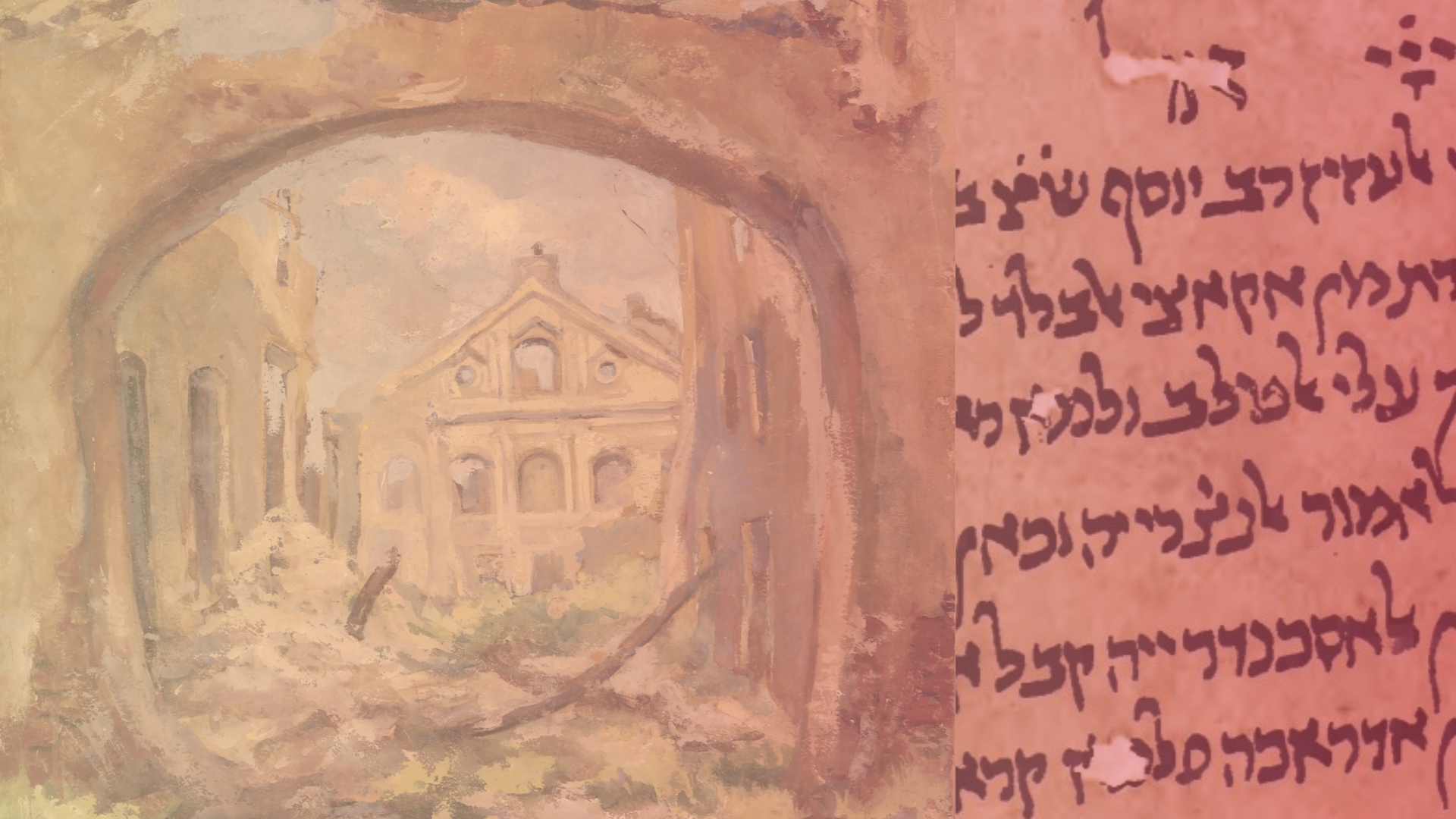
Imagine walking into The Soraya’s gallery this winter, and the air feels thick with conversation. The David Labkovski Project (DLP) has designed their current exhibition, Through the Eyes of David Labkovski: Sholem Aleichem and His Heroes, as an immersive exchange between two artists instead of a static display. Dedicated to Holocaust education and promoting historical dialogue through art, the DLP preserves and promotes the legacy of Lithuanian artist David Labkovski, whose works depict life before, during, and after the Holocaust. Labkovski’s paintings hang beside excerpts from renowned playwright and author Sholem Aleichem’s stories with an accompanying multimedia video installation.
The exhibition opened on September 13 and runs until December 31, 2025, at The Soraya Younes and Soraya Nazarian Center for the Performing Arts in Northridge, California. It stages a dialogue between the life Aleichem captured before the devastation of World War II and the loss Labkovski recorded after. One wrote the music of everyday life; the other painted its silence.
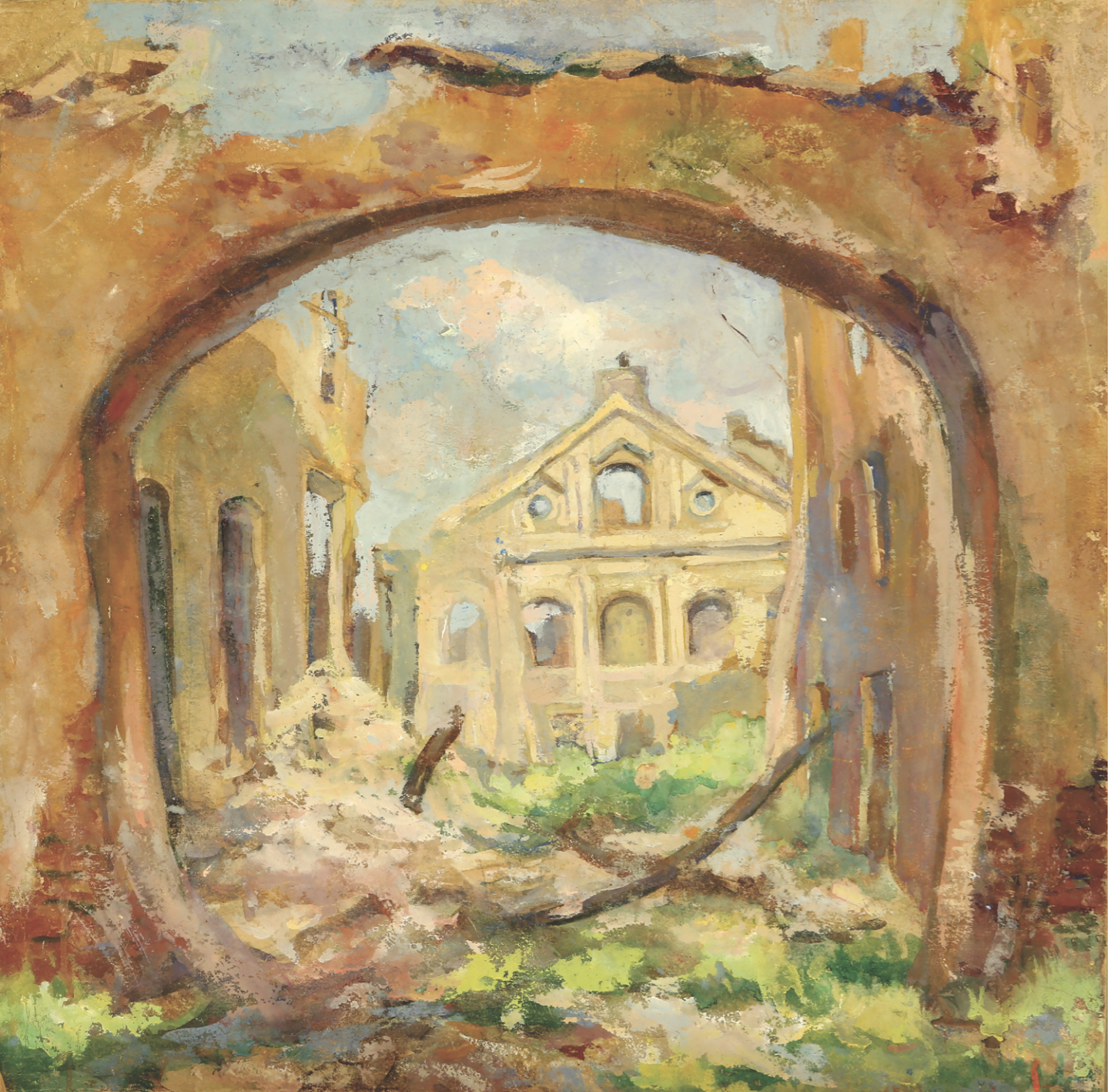
One side holds the painted world of Labkovski who was born in Vilnius, Lithuania, in 1906. He survived the Holocaust and years in Soviet labour camps before emigrating to Israel. Market squares, ghetto streets, narrow doorways, the haunted stillness of places where neighbours once stood—faces and streets rendered in vast shades of watercolour and oil, each brushstroke promising a refusal to forget. Each canvas is anchored in something he saw or knew would vanish without record. Decades earlier, Aleichem had been writing the life of those same towns before they disappeared. He used humour as a kind of armour. Often mistaken for sentimental folklore, Aleichem’s stories are layered portraits of a community negotiating hardship and change with resilience and grace.
What’s most striking is how seamlessly Labkovski’s paintings and Aleichem’s words speak to one another. A gesture or a glance in paint seems to echo a sentence written decades earlier; a line of text, in turn, illuminates a figure caught mid-breath on the canvas. Seen together, their work reveals how humour and heartbreak coexist, how both artists used storytelling to preserve dignity amid loss. The result is a dialogue that transcends time, inviting viewers to witness memory as a living exchange rather than a distant past.
This is not only an art show but also a community space for remembering. The Soraya, a cultural hub in one of Los Angeles’s most diverse regions, serves audiences as varied as the city itself: students, educators, members of the Jewish diaspora, and curious visitors. Here, they may find themselves picturing the uneven clatter of a water carrier’s cart, the flicker of candlelight before the advent of electricity, or the layered conversations of a small-town street. The particulars may belong to another century, but the emotions of love, envy, friendship, and ambition are timeless.
The debut in Northridge is only the beginning. Built to travel, the exhibition is intended for museums, universities, and community centres across the country, bringing with it the DLP’s acclaimed educational programs. These workshops use art and literature to prompt personal reflection, bridging the gap between historical fact and empathizing with lived experiences. For younger generations in particular, the combination offers a way into history that is as emotional as it is informational.
For all its historical gravity, Through the Eyes of David Labkovski: Sholem Aleichem and his Heroes is not a memorial in the conventional sense. It is a meeting between a pen and a brush, between what was lived and what was lost, between memory and imagination. It invites visitors to stand in the space between, to listen, and to carry the conversation forward.

Festival of the Daughters: Recipes
The seventh night of Hanukkah ushers in Chag Habanot, a special evening for many Jews around the world because it celebrates the connections between women, especially mothers and daughters.
Chag HaBanot is a North African Jewish tradition that honours the story of Judith, a heroic Jewish widow who saved her people from the Assyrian general Holofernes. This night can also be referred to as the Festival of the Daughters, which also marks the start of the month of Tevet and is commemorated by singing, dancing, gift giving, and telling stories of Jewish heroines.
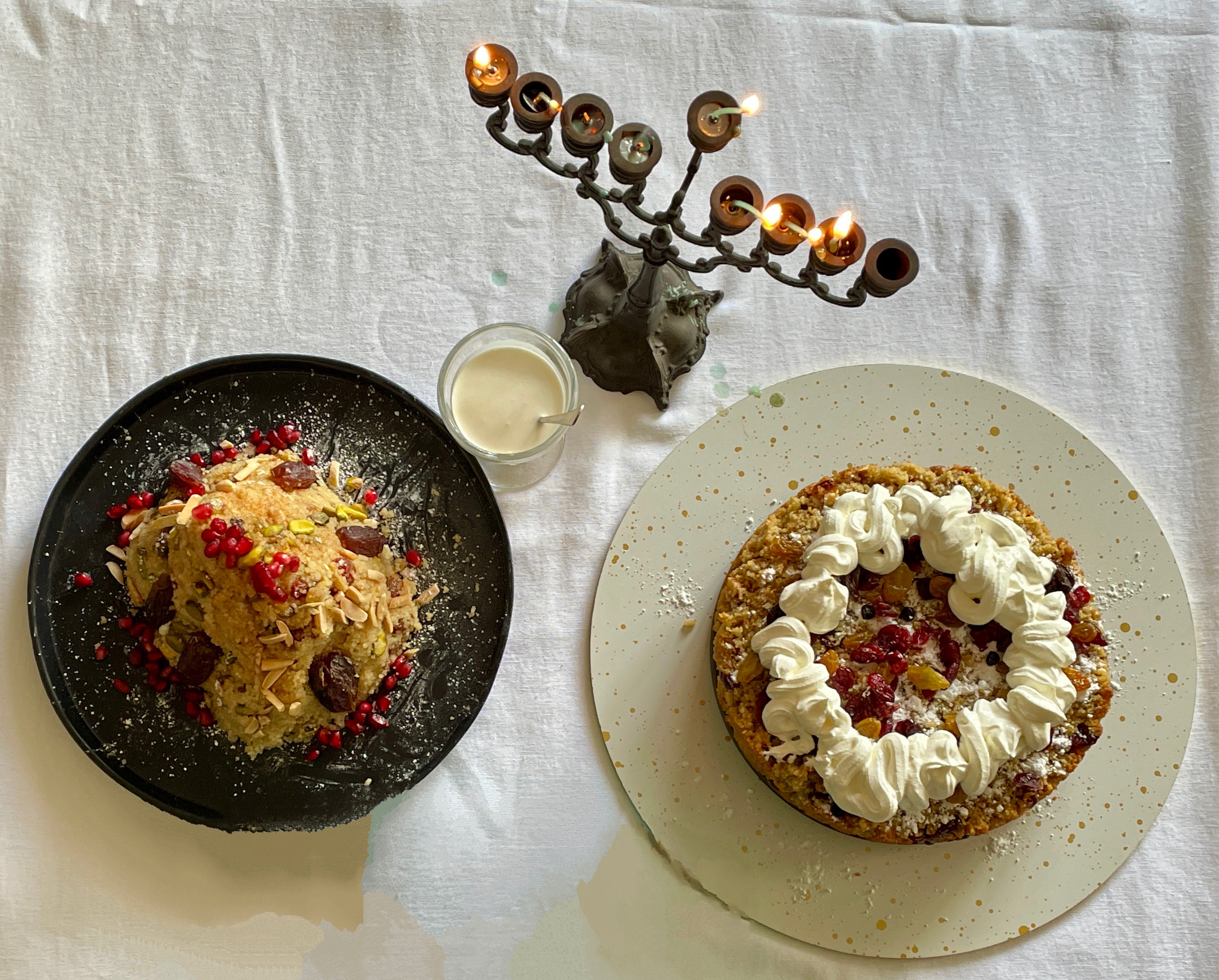
Traditional holiday foods in Jewish communities from Algeria, Libya, Tunisia, and Morocco often includes sweetened couscous. Dairy foods are also served since Judith executed an enemy general after plying him with cheese to make him thirsty and wine to make him sleepy.
The Sweetened Couscous and Fruit and Nut Couscous Cake recipes below reflect some of these customs and make great additions to any Hanukkah holiday dinner.
Sweetened Couscous
Serves 6–8
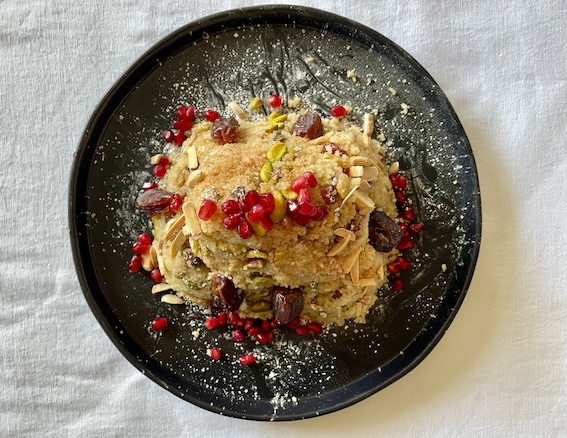
Ingredients
1 1/2 cup water
1/4 cup butter plus 1 tablespoon
2 tablespoon sugar
1/8 teaspoon salt
1 cup couscous
1/2 cup plus 1 tablespoon powdered sugar
1/2 cup raisins or chopped dried fruit
1/2 cup unsalted, slivered almonds (raw or roasted)
1/2 cup unsalted, shelled pistachios (raw or roasted)
1/2 teaspoon plus 1 teaspoon ground cinnamon
1/4 teaspoon orange blossom water or rose water, optional
Garnishes (see below)
Milk or cream for serving
Directions
- Place the water in a small pot with 1 tablespoon butter, 2 tablespoons of sugar, and salt. Cover and bring to a boil over high heat. Stir in couscous. Cover and remove from heat. Let it sit for 4 to 5 minutes until the couscous has absorbed the water. Fluff with a fork and break up any clumps. Place couscous in a large bowl.
- While couscous is cooking, melt 1/4 cup of butter. Stir melted butter into the couscous.
- Stir in 1/2 cup of powdered sugar, raisins, almonds, pistachios, 1/2 teaspoon orange blossom water. Mix well.
- Pile mixture into the middle of a platter and use your hands to shape into a dome, cone, or pyramid, being careful not to compress the grains. Sprinkle with 1 tablespoon of powdered sugar and 1 teaspoon of cinnamon. Decorate with selected garnishes.
- Serve with milk or cream on the side to pour over individual bowls of the sweetened couscous.
Garnishes: Press on or sprinkle with additional almond slivers and or pistachios, pitted date halves, raisins, chopped dried fruit, pomegranate seeds or other garnishes as desired.
Fruit and Nut Couscous Cake
Serves 8
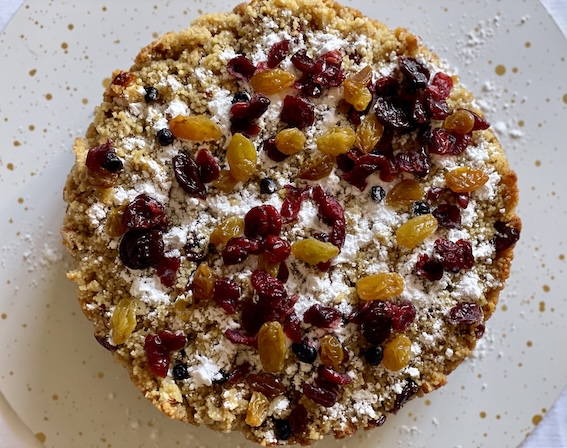
Ingredients
1 3/4 cups whole milk
6 ounces (1 1/2 sticks) butter plus extra for greasing pan
2/3 cup sugar plus 1 tablespoon
1/4 teaspoon salt
2 cups couscous
1 1/2 cups golden or other raisins (or a mix of raisins, dried pitted cherries, dried cranberries, and or dried blueberries), divided
3/4 cup chopped unsalted almonds or walnuts (raw or roasted)
2 tablespoon vegetable oil
1 tablespoon rose water or 1/2 teaspoon vanilla extract
1 1/4 teaspoon baharat spice mix (see notes)
1 teaspoon lemon juice
3 large eggs
2–3 tablespoons powdered sugar
Topping (see below)
Directions
- Heat oven to 325 degrees Fahrenheit.
- Cut a circle of parchment paper to cover the bottom of an 8-inch springform pan. Grease the top of the parchment paper and sides of the pan with butter.
- Place milk, butter, 1 tablespoon of sugar, and salt in a saucepan. Cover and bring to a simmer over medium high heat.
- Stir in couscous.
- Cover and remove it from the heat. Let it sit for 4 to 5 minutes until liquid is absorbed. Fluff with a fork and break up any clumps. Place in a large bowl.
- Add 2/3 cup sugar, 1 cup raisins, almonds, oil, rosewater, baharat, and lemon juice. Mix well.
- Separate the eggs.
- Whip the egg whites in a medium bowl until more than doubled in volume, glossy and shiny white. (Do not whip into peaks.)
- Beat the egg yolks in a separate small bowl.
- Stir egg yolks into the couscous. Gently fold whipped whites into couscous in 2 batches.
- Pour the mixture into the prepared pan and bake for 40 to 45 minutes until the mixture is firm but not hard to the touch. The edges should be brown and pull away from the edge of the pan.
- Place on a wire rack and let cool in the pan. Remove pan sides (if desired remove parchment paper and pan bottom) and then place on a serving platter.
- Sprinkle powdered sugar and remaining 1/2 cup raisins on top. Decorate with dollops of the dairy topping (see below). Serve with extra topping on the side.
Topping: Sour cream, plain or vanilla yogurt, whipped cream, or rosewater-flavoured whipped cream (whip half pint heavy cream with 2 tablespoons of sugar and 1/2 teaspoon of rose water until soft peaks form). Plan on 2 to 3 tablespoons of topping per serving plus additional for decorating.
Notes: If you can’t find baharat use 1/2 teaspoon of ground cinnamon, 1/4 teaspoon of ground cardamom, 1/4 teaspoon of ground nutmeg, 1/8 teaspoon of ground allspice, and 1/8 teaspoon of ground cloves.
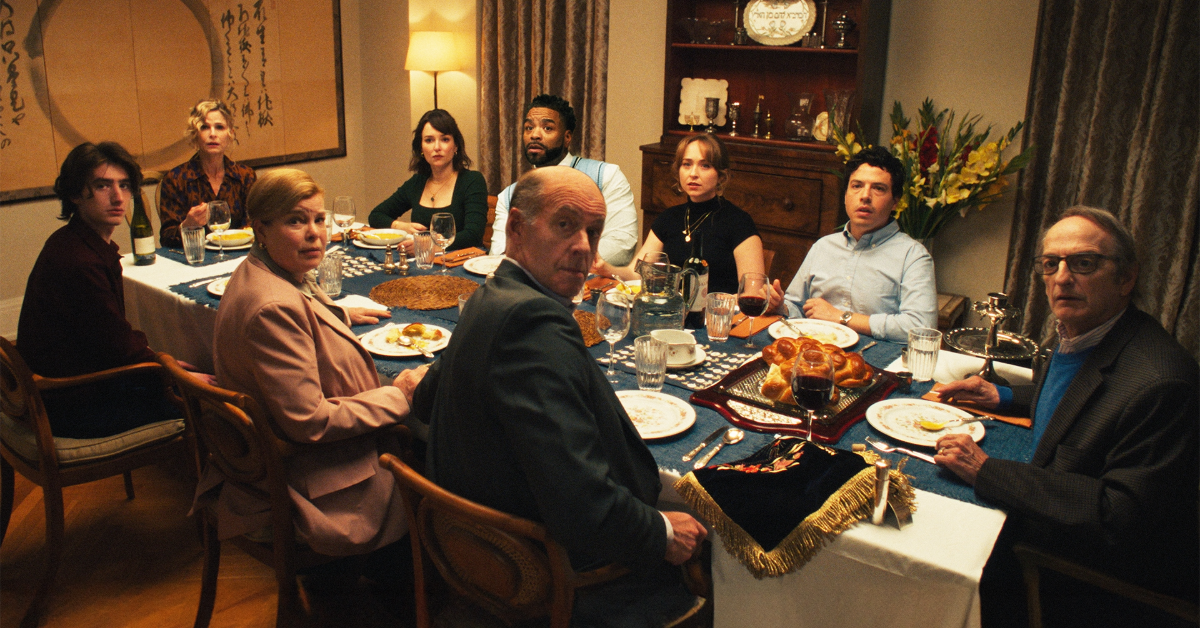
Bad Shabbos, Good Comedy
Bad Shabbos came out in theatres this spring after a festival run across Canada and the United States, winning audience awards at multiple, including Tribeca Film Festival.
The film follows a New York Jewish family over the course of an eventful, yet hysterical, Friday night. Meg, David’s Christian, converting-to-Judaism fiancé, is introducing her family to David’s for the first time, but the evening goes awry when one of the attendees is accidentally killed. Family secrets emerge, violence transpires, and some new traditions are born. I sat down with director and co-writer Daniel Robbins over Zoom to discuss the need for more Jewish holiday films, the making of Bad Shabbos, and how it was inspired by a real-life Shabbat dinner.
If Niv audiences want to watch the film, it is available on VOD as of September 16, and you can visit Badshabbos.com for more information.
Daniel! Thank you so much for your time and your film—I sat down on Friday to watch it and I was so delighted. I thought the film was hysterical. You co-wrote the film with Zack Weiner and I know that the two of you are frequent collaborators. Can you tell me about the process of co-writing?
The process on every movie is different because every movie needs a new approach. Zack [the co-writer] is better at dialogue and I’m better at structure and refining, so we just play to those strengths. But we both chip in on each other’s work. We have different strengths and we have the same taste.
You have an incredible cast in this film—Kyra Sedgwick and David Paymer as David’s parents; Method Man; and then the main characters played by Jon Bass, Milana Vayntrub and Meghan Leathers. Who was your favourite character?
I think the dad. His inability to deal with any situation was so funny. He would run off when he was uncomfortable and start rocking himself and praying.
Did you prioritize casting Jewish actors for the Jewish roles? How did you navigate that?
I actually am not draconian about that; I think actors can play different roles. The key is to go with the best actor for the role. For this one, we were big on casting for authenticity. We looked at the actors we wanted and they all ended up being Jewish, but that wasn’t a rule that we had. I do think if you’re trying to cast something authentic, it might steer you in that direction. Every Jewish character was Jewish, and every Christian character was Christian in the movie. So, nobody is complaining.
I really love films that take place over the course of one day, or one night, as this one was. Can you speak to what it was like writing a film that transpired within a very short period of time?
It was always the plan to do it this way because we wanted it to take place during Shabbat dinner. Once you get into Saturday night, the rules change and it’s not as fun, so I think this timing helps for the tension. The goal was to write something we could film and that we could pull off, so that meant one location and a compressed timeline. And that ended up helping the movie ultimately.
Your previous film was horror, whereas this one is a dark comedy. Did you feel it was a strange transition genre-wise?
It worked because comedy was where we started and what we always wanted to make. So horror was kind of the side mission, the place to start and learn filmmaking, and to make a movie where you could maybe get your budget back. Once we felt like we were better at filmmaking, then we wanted to make comedy. I still think it was the right move to start in horror because to make an indie comedy is difficult.
I’m curious if any part of the film was inspired by a real-life Shabbat dinner. Did you experience a particularly traumatic one at some point?
The inspiration of the movie was Zack’s family's Shabbat dinners, because his mom would sometimes do a prank on someone just to keep things light. Our producer heard about this, and he said, “it would be funny if you do a Shabbat dinner, and something goes wrong and someone ends up dying.” Zack thought that would be a pretty funny movie. They called me and we started outlining. We invented all these funny characters and came up with all these different ideas—Jewish boy, Christian girl, what if it’s the night her parents are meeting his family for the first time, what if you make Method Man the doorman. Sometimes the more ideas you add, the tower just collapses, but with this one it just kept getting better.
Were there any other ways in which you drew on your own upbringing or family experiences or dynamics in creating Bad Shabbos?
General modern Orthodoxy is not often portrayed on screen. You either see Ultra-Orthodox or Reform, and I haven’t seen the middle of the spectrum, which is how we [my friends and I] grew up. We love how we grew up! We love Shabbat dinner and Judaism, and the balance of the secular life and the religious life, and how those two can be combined to create a more meaningful life. We wanted to make a movie in that world, where the characters aren’t trying to run away from Judaism or self-actualize. They love the traditions and are trying to absorb them into their lives and find the middle ground with their parents. That’s the journey that we are on and a lot of our friends are on, and that just felt like the story we wanted to tell.
In terms of the Jewish audience, were you worried about portraying certain stereotypes that some people might object to? Did you and Zack worry about how Jewish audiences would receive certain jokes or portrayals in the film? For example, the mother objecting to the Christian fiancé, even though she is converting.
There’s this line from Alain de Botton that stereotypes are dangerous not because they’re untrue, but because they’re artificial articulations of a much more complex truth.
For example, the Jewish mother stereotype: I think it’s dangerous if it’s general and you get it wrong. And I think the wrong version is if you make the character cold and mean. But I think we got it right. Kyra Sedgwick played it from an intelligent place. She played the character as a warm, loving person because anyone who knows a Jewish mom knows how caring they are. They always want to make sure everyone has eaten; they care about everyone around them. Then we show how her passing on this faith, that’s been passed down through all these generations, is important to her. She’s nervous it might not continue if her son marries this girl.
Jewish moms have responded really positively to this portrayal because they feel like it got to the truth of it.
We are in the realm of stereotypes but if you do it right then it’s okay. That’s why we gave her a whole monologue, so that audiences understood where she was coming from.
Did you intend to explore intergenerational dynamics in the film, or different interpretations of Judaism depending on the generation?
Our parents’ parents came to this country from Europe, and Judaism was so important to them and something they really had to fight for. Our parents grew up, generally, in a more relaxed environment, where Judaism was part of their tradition but it wasn’t something that had to be fought for. When they pass it down to their kids, there tends to be a slightly more lax attitude. The kids don’t feel how difficult it is to hold on to, so they might approach the traditions in a more casual way. You can see that in the characters in this film.
Congratulations on winning the Audience Award at the Tribeca Film Festival! What was it like?
It’s been amazing. We’re all from New York so maybe there was minimal voter fraud with our family, but with three screenings and over a thousand people, you can’t tilt the vote that much. I think people were just relieved to see a comedy that made them laugh out loud. I mean, the film is a farce and a little insane, but it does end on a heartwarming note of accepting differences, and learning how to work within them.
You know, a couple of complaints here and there . . . but we’ve got a Jewish audience. If you don’t get some complaints, then something is wrong!
How has the festival run been going?
From there we played other festivals and also won more audience awards. After winning in New York, we said, “Well of course—it’s a Jewish movie, it’ll work in New York” —but then, once we won the audience award in Reno Nevada at the Cordillera International Film Festival, people were like “Okay, I guess it’s just working!” It recently passed $1 million in the box office because people keep telling their friends. I’d argue that Jewish WOM might be the most powerful word of mouth. Because they really know how to get the word out.
I’ve seen comparisons of Bad Shabbos to Shiva Baby, and I do love this idea of an unintentional series of films about Jewish holidays or events that turn out really badly. What do you think of doing a Passover Seder version of this?
Bad Seder could be good; we have an idea for a Hanukkah movie. I think it’s a slightly more popular holiday and also, I always wanted a Hanukkah movie to watch when I was growing up. I know there’s 8 Crazy Nights but we need more. So it might be our next movie, we’ll see. And if that goes well, then maybe the third one might be Bad Seder.
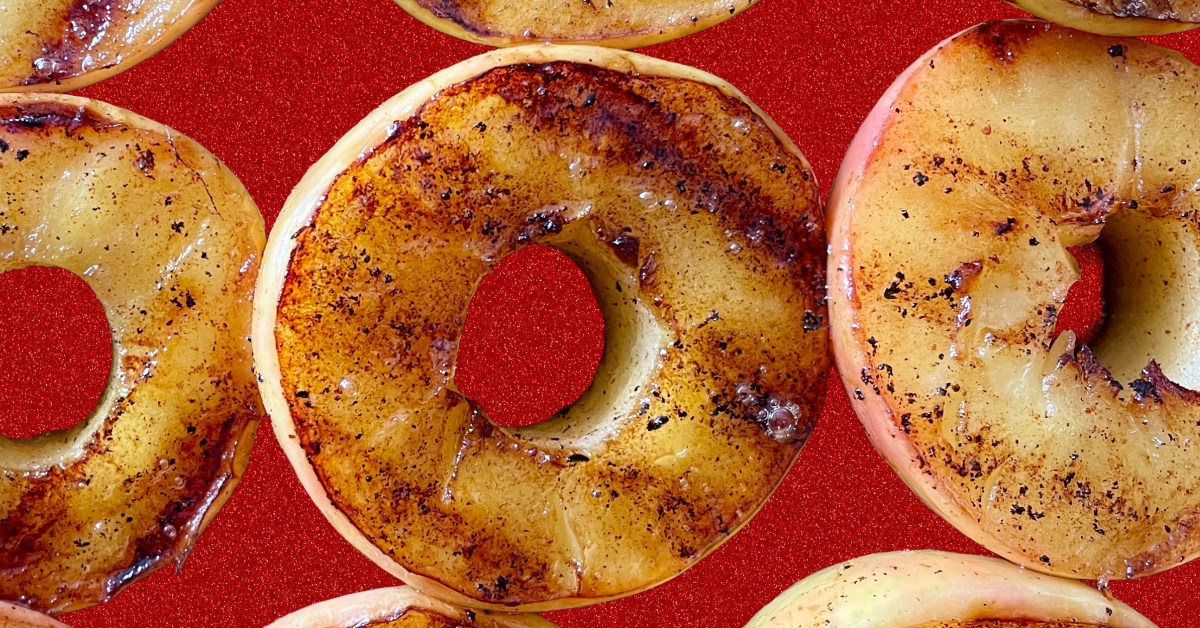
Apples and Honey Recipes to Delight
Dipping apples into honey. Is there a more classic taste for the New Year?
The combination of apples and honey is a frequent treat during Rosh Hashanah because together they symbolize a wish for a sweet and fruitful New Year. Apples are said to represent the full circle of the year, and honey represents the sweetness and happiness we wish for.
Here apples and honey are combined in two new ways for the High Holidays.
For vegan variations of both recipes, substitute agave syrup for the honey.
Honey-Curry Popcorn with Apples and Nuts
This recipe is sweet, slightly spicy, salty, and crunchy—and based on how quickly my taste testers devoured it, impossible to stop eating. Serve it as a pre-dinner munch, or as a snack during the holidays, or any time of year.
Makes 8 Cups
Ingredients
1/2 cup coconut oil, at room temperature
1/2 cup honey
2 cups raw pecan halves
6 cups plain, unseasoned popped popcorn (see notes)
1.5 ounces (40–45 grams) freeze-dried apple slices (see notes)
Spice mix (see below)
Directions
- Line two baking sheets with foil. Heat oven to 350 degrees Farenheit.
- Measure coconut oil when it's solid and place it with honey in a large pot and stir. Cook over medium heat until oil is melted and mixture is hot.
- Stir in spice mix. Add nuts and popcorn, stirring until well coated. Spread popcorn mix in single layers on prepared baking sheets. Bake for 25 minutes.
- Turn the mixture with a spatula, separating the clumps. Bake about 25 minutes more until popcorn is dry and somewhat crisp and nuts are toasted (popcorn will continue to crisp up as it cools).
- Remove from the oven. Separate the clumps. Let it cool.
- Break freeze-dried apple slices into 1/2-inch pieces and mix with popcorn and nuts in a large bowl. (Store airtight at room temperature for up to a day.)
Spice mix: In a small bowl combine 1 tablespoon onion powder, 1 tablespoon garlic powder, 1/4 to 1/2 teaspoon cayenne (or to taste), 2 teaspoons kosher salt, and 1 1/2 teaspoon curry powder.
Notes: I recommend popping your own popcorn in an air popper or in a microwave without oil or salt. Freeze-dried apple slices are available in many supermarkets and specialty stores as well as online. If your custom is to avoid nuts during the holiday, replace pecans with 2 cups additional popcorn.
Grilled Apple Crumble
The Grilled Apple Crumble has two parts. First are tangy charred grilled apple halves basted with honey and lemon marinade that are a dessert by themselves (see variation). The second is a baked treat with the grilled apples topped with a simple crumble for a homey but special dessert for Shabbat dinner or for High Holiday meals.
Grilling the apples intensifies flavours and adds a bit of smokiness. No grill? No problem. See the recipe for alternatives. Both the grilled apples and baked crumble can be made ahead.
I serve this parve dessert with non-dairy ice cream or coconut whipped topping with a drizzle of honey on top.

Serves 6-8
Ingredients
1/4 cup plus 2 tablespoons lemon juice
2 pounds (about 900 grams) small apples (see notes)
1 cup oil, divided, plus extra (see notes)
1/4 cup honey
1 teaspoon ground cinnamon, divided
1/2 teaspoon salt, divided
1/2 teaspoon ground nutmeg, divided
1/4 teaspoon ground cloves, divided
1 cup flour
1/2 cup rolled (old-fashioned) oats
1/2 cup sugar
1/2 cup plus 2 tablespoons brown sugar
1 tablespoon parve/vegan margarine or plant-based butter
Directions
- Fill a large bowl with cold water and 2 tablespoons of lemon juice. Halve and core the apples, placing halves in a bowl as you work. (Peeling optional.)
- In a separate large bowl, mix honey, 1/4 cup lemon juice, 1/2 cup oil, 1/2 teaspoon cinnamon, 1/4 teaspoon salt, 1/4 teaspoon nutmeg, and 1/8 teaspoon cloves.
- Drain apples (discard water) and add to marinade, turning to coat completely.
- Let it sit, turning occasionally for 20–30 minutes saving liquid. Reserve 3 tablespoons of the saved marinade for baking.
- Oil the grill rack and heat the grill to medium. Grill apple halves, adjusting the heat as needed. Brush with the remaining unreserved marinade and turn occasionally until softened but still somewhat firm, about 5–10 minutes total. (This can be made ahead. Refrigerate for up to 3 days mixed with reserved marinade. Bring to room temperature before continuing.)
- Apples can also be cooked indoors on a stove-top grill pan or electric grill on medium high. Alternatively, bake until softened but still somewhat firm in 350 degree Fahrenheit oven in a broiler-safe pan. Remove from oven. Preheat broiler. Brown apples under broiler. Timing varies.
- Heat oven to 350 degrees Farenheit. Oil inside of 11-inch by 7-inch (28x18 cm) baking pan. Squeeze in as many halves as possible, cut side up in a single layer. Chop leftover halves and scatter to fill gaps. Drizzle with reserved 3 tablespoons of marinade. (If using apples grilled in advance, bring to room temperature, place halves in pan, and drizzle with liquid from container). Sprinkle with 2 tablespoons of brown sugar.
- Combine flour, oats, sugar, 1/2 cup brown sugar, 1/2 teaspoon cinnamon, 1/4 teaspoon nutmeg, and 1/8 teaspoon cloves in a medium bowl. Add 1/2 cup oil. Mix with fingertips until clumps the size of a small pea form. Spread evenly on top of apples.
- Cut margarine into bits and dot over topping. Bake for 30–35 minutes until the apples are soft and the topping is browned.
- Serve hot, warm, or room temperature. (Can be made a day ahead. Cover and keep at room temperature. To rewarm, place a foil-covered pan in a 350-degree oven until the crumble is at desired temperature. Remove foil. Bake for 5–10 minutes to recrisp the topping.)
Notes: 2 pounds. equals about 8 small apples, each about 2 inches in diameter. Use pink ladies, gala, honeycrisps, or similar. Use grape seed, safflower, sunflower, or other neutral-tasting oil. Replace flour with gluten-free one-for-one flour substitute if desired.
Grilled Apple Variation: Grill apple halves as directed until completely tender and soft but not mushy. If desired, combine 2 tablespoons of brown sugar with reserved 3 tablespoons of marinade, cook over medium low heat until thickened and syrupy. Drizzle over apples.

The Best Books of 2025 (So Far)
As summer winds down and days start getting shorter, I’m looking forward to curling up inside with some good reads. Here are some of the best books of the year (so far), in no particular order.
Fundamentally by Nussaibah Younis
This is a heartfelt but irreverent and sometimes scathing look at aid workers in the Middle East, seen through the eyes of a Western woman, Nadia, who works in international development and joins the UN in Iraq to “deradicalize” ISIS brides. The novel also examines the different reasons women become radicalized (which include the women who didn’t have a choice). However, sometimes the characters, like the aid workers, fell into stereotypes, and some of the radicalized women felt like caricatures. Younis was skilled at illustrating the nuances of Nadia’s reality because of what she witnessed throughout her career in international development.
Hunchback by Saou Ichikawa
Hunchback, written by Saou Ichikawa was originally published in 2023 in Japan. The English translation of the novel, by Polly Barton, debuted in March. The story follows a disabled woman living in a care home following the death of her parents. The novel illustrates the limitations of her life, as well as her economic privilege after her parents left her with full-time care and a significant amount of money. She expresses herself by writing erotica on the Internet, and finds a community where she can be herself without being defined by her disabled body. While parts of this book were difficult to follow at times, particularly the twist at the end, it’s an important book with a lot of heart in addition to societal commentary about disability rights, both in Japan and globally. Ichikawa herself has congenital myopathy and uses a ventilator and electric wheelchair.
The Immortal Woman by Su Chang
Highlighting a Canadian independent publisher, House of Anansi, with this wonderful and immersive tale of a mother and daughter in China and beyond. Chang crosses generations and oceans to deliver a nuanced and well-researched look at 20th century Chinese politics, what it means to be an immigrant, and how nationalism can positively and negatively impact generations. Chang’s immense amount of research is evident in how her descriptions of everyday life feel immersive and almost real. This is a moving, character-driven story of two women at its heart.
All the Parts We Exile by Roza Nozari
This memoir is by another Canadian author, detailing what it was like growing up queer and Iranian in the suburbs of Toronto. Readers follow Nozari’s struggles with her identity and her difficult relationship with her mother. From Canada to Iran, we see her exile parts of herself, her family, and her history, only to reunite with her mother and reconnect with herself as she learns more about feminism, her family history, and how they shape who she is. Watching as Nozari slowly came to see her mother as an adult, rather than a parent on a pedestal, was a cathartic experience and something most daughters can relate to as they come of age. This is an immensely moving memoir that I highly recommend.
Sisters of Fortune by Esther Chehebar
Described by the publisher as a Jewish Jane Austen, this book follows three Syrian Jewish sisters in New York as they each struggle to find husbands (despite actually trying) and make their way in the world. I really loved this book and kept telling my friends as I was reading it how little we discuss Mizrahi Jews in North America. From their grandmother speaking in Arabic, to the wonderful descriptions of food, Chehebar is using language and food to immerse the reader in a world they might not be familiar with.
Red Clay by Charles B. Fancher
Based on the author’s own family history, this is an epic tale of the American South during Reconstruction, as enslaved people struggle to make their own way in the world. The book follows Felix Parker, the main protagonist, and Adelaide Parker, the now elderly woman whose parents enslaved Felix and his family until slavery was abolished. Balancing both of these family stories is tough, but Fancher is a deft author and keeps the reader engaged at every turn while not shying away from the harsh realities of this history. A difficult but necessary read about American history and its lingering impact.
Girls Girls Girls by Shoshana von Blanckensee
A Jewish take on San Francisco, this book follows two high-school grads who road trip across the country to be out as lesbians in San Francisco in 1996. This novel celebrates the queer community, found family, and Jewishiness, while also delving into the struggle of finding yourself and your people in a new place. I particularly enjoyed the sense of community from the strip club where the friends get lucrative jobs. Between their job and their gross apartment they discover from a stranger in a donut shop, you can really feel the gritty side of San Francisco throughout the novel. I am glad I could bear witness to this piece of queer history. I also loved the Jewish representation throughout the novel, from the use of Yiddish, to the mentions of holidays, to the beautiful statement from the protagonist’s bubbie that there are so many ways to be Jewish.
Punished by Ann-Helén Laestadius
This is the second in a trilogy of books by Laestadius that depict different aspects of life and history of the Indigenous Sami people in Sweden. Punished follows a number of characters as they reflect on the traumas of their time at a government boarding school as Sami children. For those of us in North America, this is an eerily similar history to our own treatment of Indigenous communities, making it a critical and relevant read. There are many aspects of trauma highlighted in this book that raise ethical questions about what survivors of abuse and trauma are entitled to. It also shows us how compounding abuse can impact a life. A difficult but necessary look at the recent past.
Disappoint Me by Nicola Dinan
Poet and tech company worker Max starts dating Vincent, a corporate lawyer and cis-man who loves Max and isn’t afraid to show it—but he has a secret from his university days that might threaten the very foundation of their relationship. Dinan is talented at portraying complicated characters making questionable choices. Even as people show the worst parts of themselves, the narrative offers empathy and nuance. In the current cultural climate, this is an important look at how trans people just want a safe landing place and the chance to build their own life.
Liquid: A Love Story by Mariam Rahmani
This is a fantastic coming-of-age novel that follows an unnamed bisexual Iranian woman who splits her time in Los Angeles and Tehran deciding if she should commit to finding a wealthy spouse. She is so dedicated to the plan that she sets up a spreadsheet to track the 100 first dates she has decided she needs to go on to find someone. She is doing all of this with the reluctant support of her very devoted male best friend. The best part of this book for me was her time in Tehran during her father’s illness. She falls for his female neighbour, and it’s a wonderful and little-seen look at the vibrant underground queer scene in Iran. While you know where the story is going to end up the whole time, it’s still a compelling, hilarious, and sometimes painful journey to get there.
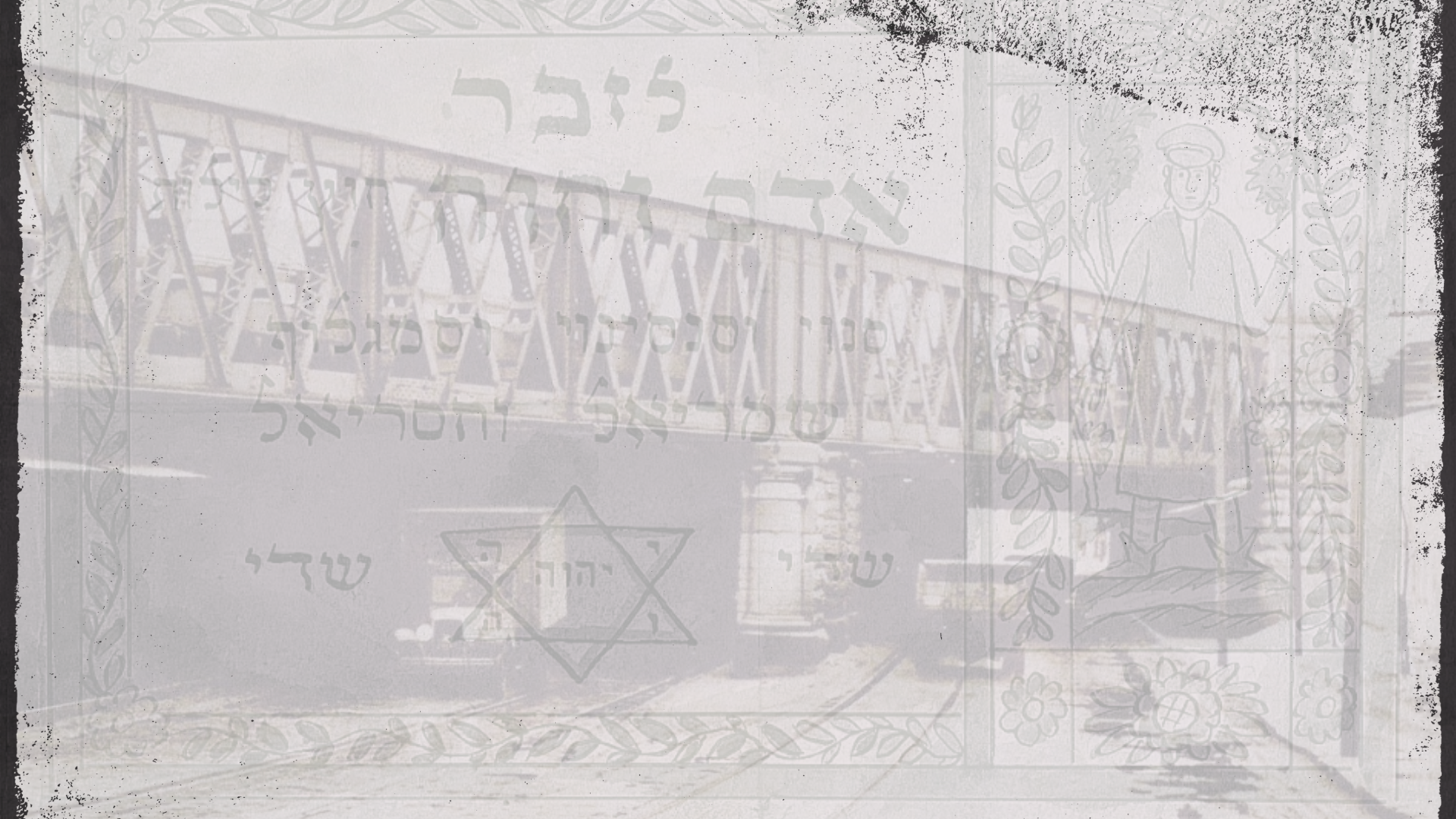
Jessie’s Father
Many, many years ago my grandmother, Jessie, told me a story. After she gave birth to my father, she became very ill, and stayed in a hospital for a long time. Everyone thought she was going to die. Her father, Louis Sacofsky, came to visit her on her sickbed. According to Jessie, her father prayed for her, and in his prayers he begged God to take his life and let his daughter live.
When he left the hospital, he was promptly hit by a train, dying instantly. She miraculously recovered.
My family during this time were observant Jews from the old country, filled with religious belief and practice, and at times, to my mind, tainted with superstition. When she told me this tale, I was skeptical and didn't take it seriously. My grandmother provided no details, so I was left to imagine a dreamlike sequence of events, conjuring images of this old man with a full white beard leaving the hospital and, somewhere on an abandoned stretch of railway track, was struck down by a train. It seemed to be quite a stretch and I don’t remember anyone in the family ever talking about it. My father, who was only one years old when this supposedly happened, never knew his grandfather, so this story must have been as abstract for him as it was for me.
Some fifty years later, I discovered through an old newspaper article (which my sister received from an ancestry service) that the story was not only true but remains a chilling mystery.
On the morning of July 12, 1921, Ben Weinkofsky, Jessie’s brother-in-law, walked to the Bridgeport Railway Station to see if he could get any information about his father-in-law, who had not returned home from a trip to New York City the day before. The ticket agent called their supervisor. To Ben’s surprise, he was given the name of a Detective Williams and told to visit the police station.
At the station, Detective Williams was called to the front desk and took Ben to his office. Ben explained that his father-in-law, Louis Sacofsky, was missing. His wife had been expecting him for dinner, but he never arrived. After giving background details and a physical description, Ben was informed of a terrible accident that night involving a man of a similar profile, but they could not identify the victim.
“We don't know if this individual is related to you in any way,” said the detective, “but from your description it might be possible. He was struck down by the New Haven train on the King Street Viaduct just outside of Stratford. Was there any reason for your father-in-law to be in Stratford last night?”
“No, he was expected home here in Bridgeport returning from New York. He did not go to Stratford.”
“Well, perhaps it’s not your father-in-law,” said the detective. “The body was badly mutilated and there was nothing on his person to identify him. But we found this note in the outside breast pocket of his blazer. Does this mean anything to you?”
Ben looked at the handwritten note. Initially, he was confused but suddenly caught his breath, turned white, dropped down on the chair, and gasped, “Oy gotenyu!”
“What is it?” said Williams.
To himself, desperately: “No, no! ” He went silent, then muttered quietly, “This is the address of the hospital where his daughter is in New York. He went there yesterday to visit her.”
When Ben arrived home he was still as white as a sheet. His wife, Lillian, her mother, Rose, and her brothers Harry, Harris, and Samuel were waiting for him. He walked to where Lillian was sitting, knelt, took her hands and said “Tate ist toyt,” as tears filled his eyes. There was a terrible accident.
This was a horrible shock. Louis Sacofsky was the central figure in all their lives. He was the founder and owner of the clothing company where they all worked, he owned the apartment where they all lived, and he was the one who had brought the entire family—wife and five children—out of Czarist Russia, across Europe, and over the ocean to America. That was twenty-five years ago. It was inconceivable that this man was gone. The loss to the family was devastating.
Funeral arrangements were made quickly. However, in addition to the loss, there was unsettling confusion within the family concerning the circumstances surrounding the father’s death. No one could understand what he was doing on a train trestle in Stratford.
When they heard that the Fairfield County coroner was going to investigate the incident, the family acquired legal representation from attorneys Israel Cohen and James Shannon. Unfortunately, the coroner’s investigation focused mainly on the liability and possible negligence of the railroad and railroad personnel. The coroner found the incident to be an accident with neither individual nor company negligence. The authorities, as a result of the inquest, unfortunately, were unable to determine how Louis Sacofsky came to be on the train tracks of the King Street Viaduct at 9:30 p.m. on July 11, 1921.
Family members hypothesized that he had fallen asleep and missed his stop at Bridgeport, then woke up and jumped off the train as it slowed between stations, thinking to walk back.
But there was no proof or witness to support this theory. In fact, railroad personnel had testified specifically that the train had not slowed down before reaching Stratford. Further, the night watchman stationed at the bridge swore that no one had attempted to cross on foot that night or any other night. And yet, as the engineer of the New Haven express train stated, he’d seen the victim about 100 feet ahead of him, standing on the side of the track on the King Street Viaduct. He’d sounded the alarm, applied the emergency brake, but it was not physically possible to bring the tremendous weight of the engine and nine cars to a halt. The engineer saw the last moment of the victim’s life as he raised one arm as if to shield himself from the impact.
As part of the coroner’s investigation, an effort had been made to confirm that Louis Sacofsky had indeed been a passenger on the train from New York to Bridgeport. A wiry, dark-haired gentleman named Wagner confirmed this finding because he’d been standing in the ticket line directly behind Sacofsky at Grand Central Station. He said he knew Sacofsky because he was once a tenant of his. Wagner stated that Sacofsky asked the ticket agent when the next train to Bridgeport was leaving. The agent replied, “There’s one leaving now,” and Sacofsky made his way directly to the platform with Wagner close behind. Wagner saw Sacofsky seated in the last car as he walked past him.
The only other witnesses who might have seen Sacofsky in Stratford were the two young ladies on the Stratford platform. These were the Hamilton sisters, but they were never called to testify. There did not seem to be any explanation for his presence on that viaduct. No one had seen him leave the train, the train had never slowed to let him off, and no one had seen him step onto the tracks.
Louis Sacofsky had breakfast with his wife Rose on Monday morning before catching the 9:05 p.m. train to New York. They had talked about his trip as a last hope for their daughter who had become dangerously ill and hospitalized for many months after giving birth to their grandson. Louis had withdrawn $300 as a gift to a scholarly Jewish organization, which was part of the Kabbalah ritual that he planned to perform with a special rabbi that day to help heal his daughter.
But Rose was worried. “Sometimes terrible unexpected outcomes happen,” she said.
“Maybe” said Louis. “But this could be our last hope. Think of the miracles that Reb Mendel has brought forth in the past. He once saved a whole village by dreaming about the storm to come. I will talk to the rabbi today and hope he can do something for us. We are good people, Rose, so is Jessie, and the baby is an innocent who deserves to have a mother. Let us have faith.”
Louis spent an hour with Rabbi Mendel, then left his study on Hester Street to make his way to People’s Hospital, some twenty blocks north on 2nd Avenue, where his daughter was being treated for childbed fever (what the doctors called puerperal sepsis) and did not have a positive prognosis. She’d been in bed for eleven months, was very ill, and many people thought she would die. Louis was not quite ready to accept this diagnosis, and was prepared to go to great lengths to do whatever was humanly, or spiritually, possible to save his daughter’s life. She was only twenty-seven and had just given them a new grandson, Milton. And it was a sin that the little baby should be made an orphan. He refused to accept that this was the Lord’s will. Before heading uptown, he stopped at the shop Z. Rosenthal’s to buy a prayer candle, just as the rabbi had told him to do. He planned to walk the whole way to the hospital. The day felt holy, and just as he would on the Sabbath, he wanted to walk to his destination on foot. It was a hot July day. He stopped for a moment under a tree when the heat became oppressive. He took the note out of his jacket pocket and double-checked the address—yes, between 11th and 12th Streets. He was very near.
When he entered his daughter’s hospital room, she was in bed sleeping. He bent over and kissed her forehead and said, “Oy mayn klynikeh Yessele.” He looked deeply and affectionately at her face. Then, after a moment, he sat on the chair next to her bed. The room was very quiet; they were alone. Louis seemed to fall in to deep, concentrated thought. His mind was actively engaged—a world of stories were running through his head. At one point a smile lit up his face; at another moment his eyes gently filled with tears. And then he slowly shook his head from side to side.
Finally, he rose and went to the wash basin at the far end of the room to wash his hands and pat cold water on his face. After drying off, he walked back to the table near the bed. Out of his pocket he placed a tissue-paper wrapping onto the table and carefully unfolded it. Inside the wrapping was a piece of parchment paper and a small leather kame’a that the rabbi had specially prepared for him. He carried it over to the bed and tenderly slid the kame’a under Jessie’s pillow. While doing so, he said in Hebrew: Yehi kame’a zeh, chatum b’shemot kedoshim, l’magen al nishmata u’gufah.
May this kame’a, sealed with holy names, be as a shield for her soul and body.
He went back to the table and lit the candle, picked up the parchment paper, and chanted aloud, three times, the prayer which the rabbi had penned for him.
רִבּוֹנוֹ שֶׁל עוֹלָם
Master of the Universe,
אָנָּא, בְּרַחֲמֶיךָ הָרַבִּים, הָשֵׁב חַיִּים וּבְרִיאוּת לְיִסְכָּה בַּת פְרוֹמֶה.
Please, in Your great mercy, return life and health to Yiskah bat Fromme.
שְׁלַח לָהּ רְפוּאָה שְׁלֵמָה מֵהַשָּׁמַיִם – רְפוּאַת הַנֶּפֶשׁ וּרְפוּאַת הַגּוּף.
Send her a complete healing from Heaven—healing of the soul and healing of the body.
יְהִי רָצוֹן מִלְּפָנֶיךָ שֶׁיִּהְיוּ דִּמְעוֹתַי לְפָנֶיךָ כְּקָטֶרֶת טְהוֹרָה.
May it be Your will that my tears rise before You like pure incense.
אִם גּוֹזֵר אַתָּה דִּין – קַח אֶת נַפְשִׁי וְהַנַּח לָהּ לִחְיוֹת.
If You have decreed judgment—take my soul, and let hers remain.
בַּעֲבוּר אַהֲבַת אָב לְבִתּוֹ, תְּקַבֵּל תְּחִנָּתִי בְּרַחֲמִים גְּדוֹלִים.
For the love of a father for his daughter, accept my plea with great compassion.
אָמֵן.
Amen.
The Rabbi had said, “Three times you must call upon the Holy One—once for her body, once for her soul, once for her child.” Then he sat back in the chair with tears in his eyes and spoke in Yiddish with deep conviction. The words burst out of him three times.
Nim mayn neshome, un loz ir zeyer blaybn.
Nim mayn neshome, un loz ir zeyer blaybn.
Nim mayn neshome, un loz ir zeyer blaybn.
“Take my soul, and let hers remain.”
At this point Jessie awoke, hearing what her father was saying, and understood his prayer. But he left the room not knowing she was conscious.
On the street he was beside himself. He felt a tremendous desire to be home with Rose. He saw a taxi and jumped in. At Grand Central, he went hurriedly to the ticket counter and asked when the next train to Bridgeport was leaving. “There’s one departing now that you can get,” the agent said. He walked quickly to the platform, not noticing the tall, thin man with the black, greasy hair following behind him—the one who had stood behind him at the ticket counter.
He entered the train in the last car and took a seat; the train was empty. Just at that moment a man came from behind turned toward and said “We’re going the same way.” The man’s eyes were shining, and his smile was one of total contentment—all of which seemed completely out of place. Louis was speechless, and the man turned and continued walking ahead into the next car. Immediately, Louis closed his eyes and fell into a deep sleep.
He dreamt he saw the face of the strange man with the shining eyes emerge from the sky, surrounded by a white cloud, smiling gently and waving him forward. As if floating through the air, Louis sees his entire family on a beach at the water’s edge—picnicking, singing, and playing games. And he, Louis, is in the midst of them, surrounded by their joy and happiness. In the distance, on a lush green meadow, Jessie is standing healthy and happy, holding her baby in her arms with her husband’s arms around them both. Then from the sky before him, two young women glide towards him—angels, who, without touching him, raise him up and carry him to a small river and place him in a basket, and he floats down the body of water. He feels, like never before, a lightness, a freedom, a great happiness. As if his whole life had great meaning and importance. A feeling of fullness and satisfaction, as if all necessities and duties in life were taken from him. He floated down the river in complete peace and harmony, with one hand raised in thanks to the Lord.
When he awoke, the train was pulling into Milford Station, which meant that he had missed his stop at Bridgeport and gone past Stratford. As he exited the train, he saw the New Haven line pulling out on the opposite platform. So his ride back to Bridgeport had just departed.
The timetable on the station wall indicated that the next train back was leaving in an hour and a half. The platform at Milford is ground level, so one could simply step directly onto the tracks and start walking. It didn’t seem particularly dangerous. If a train were to come, you could just hop off the track and stand on the grass. Louis decided that in an hour and a half he could reach Bridgeport on foot, and off he went.
After about an hour of walking, things were going fine, except he had not yet reached Stratford, the town before Bridgeport, although he could see the lights of the town in the distance. He was still feeling fairly fit, and the evening air was pleasantly cool, so he kept on going. But very soon he noticed that he was walking a bit higher off the ground than before, and realized that he was approaching a train trestle.
After another fifteen minutes he was about thirty feet above the street below and was walking on the King Street Viaduct. Here everything narrowed; there was no room on the side to stand if a train were to come by. In addition, walking itself became very difficult and dangerous—he could no longer get a solid footing. He stopped and, looking around, was overcome by a sense of dread. There was no room for escape. The cold, unforgiving, massive industrial structure of the bridge terrified him. The only thing to do was to get off as soon as he could.
He decided to turn back as he wasn’t even a quarter of the way across. After only three steps he saw the headlights coming. Just at that moment his dream returned to him and he was floating down the river and realized everything had gone as planned. He raised his hand to thank the Lord.
Louis Sacofsky died that night on the King Street Viaduct. His daughter Jessie recovered, raised her son, had three grandchildren, and died at age eighty-seven.
You Can’t Say Kaddish for a Dog
Growing up, I desperately wanted a dog. My parents made clear it wasn’t going to happen, but I never gave up hope. I borrowed books about dogs from the library. I bought a dog-training guide with my allowance. When MaryAnn, who lived down the street, said her mother hated their dog Woofy and asked me if my family would take her, I thought that sounded like the perfect idea. Later that day, MaryAnn dropped Woofy at my house after school.
When my mom got home from work she said, “Take that dog back right now.”
I assumed I’d get a dog when I became an adult. But in my twenties, my husband and I lived in small city apartments and in my thirties we adopted the cat that wandered into our suburban home’s yard.
But the cat would often run in the opposite direction when my fast-moving son wanted to cuddle or pet it, leading him to ask us, "Why can’t I have a pet who loves me? Why can’t I have a dog?"
That’s when, in my forties, I decided to get a dog. Her name was Opal. She was seven years old when we adopted her. My son was 13. She’d been surrendered because of a domestic violence situation and then bounced around homes for a year after that.
She looked so forlorn in her Facebook adoption photo that someone commented, “Please someone help this beautiful gal, she looks so sad.”
Her Petfinder description said she was house-trained, walked nicely on a leash, and was good with cats and kids. Only the first was true. She barked at and chased the cat mercilessly. On walks, she burst onto the sidewalk like a bull in a china shop and lunged and barked at other dogs, cyclists, joggers, and anyone who got too close to us.
No matter, I thought. I’d seen enough of The Dodo videos to know that with enough love, any dog can be trained into the perfect canine companion.
With consistent training and treats, Opal got the hang of suburban life, but she never achieved the viral-worthy transformation of a perfectly trained dog. You can teach an old dog new tricks, I learned, but those tricks won’t necessarily become second nature. We successfully trained Opal to look at us for a treat when a biker or jogger passed instead of barking at them; but she never lost the instinctive urge to bark and lunge with the full force of her 65 pound body.

Similarly, having guests to the house required a ritual. Telling visitors, “Do not pet the dog. She doesn’t like it,” was key. Invariably, my son would then pet her, and I would say, “Well, she likes being petted by this guy.” And what could make someone feel more special than that?
Opal never became the perfect dog, but she was perfect with our family of four. What she lacked in behavioural skills, she made up for with love, not least of all with me. When I felt her bottomless love, I remembered in a visceral way how much I wanted a dog when I was a child. I was a bit of an outsider; a bookish, sensitive child in a blue-collar town. Opal would have been perfect for that child. She was the epitome of the dog who understands her owners’ emotions. If I was sad, she would put her head in my lap; if I was distraught, she’d offer her paw. When anyone in the family was really happy—like when my daughter received her college acceptance—she’d go berserk, running around the house in excitement.
She was perfect for my son, too. People thought I was crazy to get a senior dog; didn’t my energetic boy need an equally energetic dog? You know, like a puppy. I didn’t see it that way. I saw that he needed an emotionally in-tune dog who needed him. No one could have fit that bill better than Opal (and it turned out she was full of energy).
Whatever we wanted to do, she wanted to do, as long as we did it together. When I took my son to school in the mornings, she would look at me pleadingly with the sad yet hopeful expression in her adoption photo, willing me to bring her along for the seven-minute ride. During a spirited rendition of Dayenu one Pesach, she joined in the singing.
When she saw suitcases, we'd have to put her in the car right away so she knew she was coming. When we packed the trunk, she’d look at us from the backseat and smile. Her whole life people had given up on her. I promised I never would.
At one point I wasn’t certain I would be able to keep that promise. During the summer of 2021, when we rented a beach house and had 23 people over, Opal constantly barked at all of my youngest nieces and nephews. I was worried I wouldn’t be able to keep a dog who seemed to hate small children. But later that evening, when Opal and my son were lying on the carpet together, he told her that she was “the best dog” and that he loved her. She licked his face in return. And I knew, then, that she was part of our family and that I would make it work.
Opal’s health began to take a turn for the worse when she went blind from SARDS in fall 2023. But she adjusted to blindness the way she approached everything, with courage and gusto. We had to help her down stairs and keep her from running into telephone poles on walks, but that was about it. My children adjusted to her blindness with quiet love, empathy, and deep understanding. Sometimes when my son and Opal left for a walk together, I’d peek at them from between the blinds. She would look up at him, even though her eyes couldn’t see, and he would give her a treat. They’d continue walking, and I could see her tail wagging the whole way until I lost track of them.
She acted like a happy, energetic puppy right up until the end, which is part of what made saying goodbye so hard. In her last year of life her health deteriorated. Then one Friday when my husband and I were going away for the weekend, which we rarely did, Opal was struggling to get out of bed in the morning. In a string of bad decisions I’ll always regret, I decided to go on our scheduled getaway. I told my daughter to take Opal to the emergency vet, and we would come home if it was serious. We would be only two hours away. Unfortunately, Opal’s health greatly diminished for the next week.
Three vet appointments over three days ended with all doctors agreeing she seemed to have a brain tumour
Reluctantly, I agreed to put my soul dog down.
One of the only things I remember from that appointment is the vet warning us that Opal might soil herself or experience tremors. Nothing of the sort happened. Opal took euthanasia the way she took everything else she didn’t want to happen: with grace and without a fight, in a way that was as easy as possible for her family.
I tried to find more comfort in Jewish ritual, but, for the first time in my life, my faith was a source of pain instead of comfort. A Google search revealed that you can’t say Kaddish for a dog, and Judaism teaches that animals don’t go to heaven.
When my grandmother died, I dreamt of her.
“I can’t believe you thought I died!” she’d say. We’d laugh and I’d respond, “I can’t believe I thought that, either.” Those dreams were my proof that God was real, heaven was real, and I would see my grandmother again.
The thought of never seeing Opal again gutted me. She did not come to me in my dreams as my grandmother had, which seemed proof that dogs did not go to heaven, and I would never see my precious good girl again.
The despair worsened when I reviewed the medical records and was hit in the face by the fact that it was never actually determined that Opal had a brain tumour. I’d just assumed. But there it was, on my screen: “Primary concern for intracranial disease (possible brain tumor); less likely differentials: old dog vestibular disease, middle/inner ear infection.”
I felt dizzy and couldn’t breathe. Did I kill my dog for a simple ear infection? And why didn’t it occur to me to take her back to the ER vet for an MRI to be sure?
It was one thing for other people to say confidently that this was no life for Opal and we needed to put her down. It was another thing for me, her primary caregiver, the decider. Opal counted on me to look out for her. People had given up on Opal her whole life. I promised I never would. But in the end, I gave up on her in the worst way.
There is a video of us running on the beach in the off-season. Opal is running next to me, ears flapping in the wind. When the video was taken, I thought it was a video of Opal running free. Now I see it's a video of how she just wanted to be with her people. She is free, but her un-seeing eyes are on me as we run together, her body colliding into my legs in her quest to be as close to me as possible.
“We really don’t know whether animals go to heaven,” my rabbi said when I called her, distraught over what I read. “Judaism struggles with profound unknown things, and death is the biggest.” I clung to that. We don’t know, and I just had to be okay with that.
That night, I finally dreamt of Opal. It was not a dream like I had with my grandmother. In this dream, I walked onto our front lawn in the summer heat and saw a pile of Opal’s poop on the grass. I looked up and saw her. I pet her the way she liked and whispered into her fur the way I had in life, “I love you, Opal. You’re the dog I always wanted.” I smelled her unmistakable Opal scent and thought, I don’t know how this is possible, but I don’t care. She didn’t talk to me like a person; she was just herself, loving without limit or question.
Opal was such a presence that things feel radically different without her.
Walks without her are particularly difficult for me. Sometimes during our walks, Opal would spontaneously turn around and look at me with pure love. Opal was blind, but her love was so strong that she could see me with her heart. She lived in a world of darkness but made the world so bright. She reminded us that life was full of small happy moments that, taken together, make for one happy life. This summer, going to the beach for the first time without her was excruciating, but as my daughter pointed out, we could be grateful for all the happy summers she had.

I didn’t say Kaddish for Opal because she wasn’t a person. But I find her in other prayers. In that first Shabbat after her death, I found myself sobbing when we read a prayer I’d recited hundreds of times: “Days pass and the years vanish, and we walk sightless among miracles. God, fill our eyes with seeing and our minds with knowing; let there be moments when Your Presence, like lightning, illumines the darkness in which we walk. Help us to see, wherever we gaze, that the bush burns unconsumed. And we, clay touched by God, will reach out for holiness, and exclaim in wonder: How filled with awe is this place, and we did not know it!” That spirit of optimism and faith is just like Opal, always believing she was the luckiest dog in the world, and trusting without seeing that I was always there for her.
A Memory
“A Memory” is translated from the Hebrew by Esther Cameron.
There I disappeared from their sight:
There I was swallowed up in the cool No.
Under my parents’ iron bed
on the scratchy floor planks
I ceased to be, I shuttered up; only
the acidulous fragrance of apples in the curls of dust –
There I dwelt with the crates of fruit,
stretched out in the place of freshness preserved forever.
There I breathed sweet absence.
There I silenced my heart from beating.
Who’s missing? Who’s upset?
Who’s guessing-groping-galloping
toward my hidden existence?
What a great astonishment!
Crawling on all fours
I birthed myself to my parents
who weren’t looking for me at all.
I raised my head
and I was who I was.
Almost three years old.
In The Belly of the Jewish Bazaar
Like many other boys, six-year-old Igor Novikov loved playing the game “war,” where the good guys were Soviets and the bad guys were German fascists. He had a toy gun and a saber to play out the conflict with his friends. His family lived in an area of Kiev called the Jewish Bazaar, abbreviated as Yevbaz (short for Yevrejsky Bazaar). His father, Vasily Novikov was Christian and of Russian nationality, worked as the chief mechanic at a bakery located on one of the streets adjoining Yevbaz. The bakery was in the house where Igor’s family lived. His Jewish mother, Fanya Kagan, worked as a cashier in a pharmacy located at Yevbaz. The yard of their house was divided into two parts. In the main part, called the big yard, was the bakery, and the second part was a narrow, unremarkable courtyard at the end of which was a large cellar with sheds. This house had many communal apartments.
On June 22, 1941, the residents of Igor’s house at Yevbaz woke up to the sounds of anti-aircraft fire, the roar of planes, and explosions from bombs. Sirens wailed, and everyone rushed into the basement shelter. War had come and it was far scarier than the game. The Soviet soldiers had left Kiev, while the Germans took control of the city. From the very beginning of the Nazi invasion of the USSR, numerous Soviet loudspeakers in Kiev blared: “Kiev is ours! We will not surrender Kiev! We are driving out the enemy!” Flyers with the text were pasted everywhere: “Oh, and Hitler the Bandit will get his beaten.”
Around noon on September 19, a growing rumble could be heard at Yevbaz—gunshots and the roar of engines merged into a single cacophony—the advance units of the Wehrmacht were approaching. To the victorious cries of Soviet loudspeakers, German troops entered Kiev. They rode on motorcycles, in cars, in armoured personnel carriers, in tanks, and on horse-drawn carts. Behind the tanks moved powerful trucks, followed by infantry: young soldiers in green uniforms with sleeves rolled up to their elbows, holding automatic rifles in their hands. The soldiers were sweaty and dusty, but cheerful, well-fed, and content, singing songs in German.
Vasily Novikov found himself in the city centre, on Vladimirskaya Street, in the square near the Opera House, at three o’clock on that bright, sunny day. He saw a smart, cheerful crowd walking back and forth along the sidewalks of Vladimirskaya Street. The ladies were dressed up in silk dresses and mantillas. They wore earrings and brooches. Men appeared in frock coats and elegant suits. Two or three priests came in silk cassocks. Old officials and teachers in uniform frock coats from the time of Tsar Nicholas II walked toward Vasily. He was shocked by the sight of this unprecedented non-Soviet crowd. All these people were chatting cheerfully, bowing politely to each other, as if congratulating one another on getting rid of the Bolsheviks.
The Germans sensed the festive mood of the crowd and decided to play along. They turned on Moscow Radio with loudspeakers. Terrible news spread throughout the city that Kiev was burning, set on fire by the enemy, that German soldiers were looting apartments, killing women and children, shooting men, and driving residents from their homes. These reports caused bursts of cheerful laughter among the “lucky ones” who had escaped from “Soviet hell.” Vasily looked closely at these people, who sincerely welcomed the new regime, and realized a new anthropological type of people had appeared in Kiev. They could be Germany’s allies in its solution to the Jewish question.
The entire Jewish population of the Novikovs’ house was evacuated thousands of kilometres deep into the territory of the USSR. Most families from mixed marriages remained. Fanya’s parents and sisters urged her to evacuate with them. After much thought and hesitation, she decided to stay. Those who remained in their courtyard hoped that the rumours of German atrocities against the Jewish population would not come true. Surely, the Germans couldn’t shoot old people, women, and children.
On the night of September 24, 1941, the population of Kiev woke up to loud explosions and bright flashes. Walls shook, doors and windows flew open. Panic ensued. The residents of Yevbaz did not understand who was bombing Kiev: the Soviet army had left the city, and the Germans had captured it. People did not know where to run or where to hide. Soon everything became clear: flashes were sparkling and rumbling was heard from the city centre, from the main street Khreshchatyk, where mines planted by Soviet sappers retreating from the city under the best buildings of Kiev were exploding. The city centre was on fire. Khreshchatyk became a huge bonfire. The Germans fought the fire, but could not retrieve the hundreds of corpses of their fallen comrades, which had been burned to ashes. After several days of desperate struggle with the fire, the Germans ceased resistance and only watched the fire from a distance. After four hours, the explosions became less frequent, the glow faded, but the fires continued for two weeks. The Germans declared the Jews of Kiev guilty of sabotage. They began to prepare a punitive action against the Jewish population.
The leaves on the trees of Kiev’s maples, birches, lindens, ash trees, oaks, and rowans turned yellow, red, and fell. Asters, dahlias, chrysanthemums, roses, and nasturtiums bloomed. Nature celebrated. Against the backdrop of Kiev’s beautiful autumn palette, unprecedented human tragedies unfolded in this city.
On the evening of September 28, Yevbaz did not sleep. Vasily and Fanya told Igor to go to bed early, but he could not. His mother came up to him and quietly sang a Jewish melody that he had heard before.
On the morning of September 29, Igor woke up and saw his parents standing in an embrace and crying. He didn’t understand why. He was told that his mother was leaving for a short time to visit her father. Between Igor’s father and mother, there was an open suitcase on the floor, into which they were putting her things. He also began to cry. All the Jewish neighbours gathered in the courtyard of the house to carry out the order of the Kiev commandant to appear “at the corner of Melnikovskaya and Dokterivskaya streets (near the cemeteries), taking with them documents, money, valuables, as well as warm clothes, underwear, and other items.” His mother left the courtyard with the other Jewish neighbours. Igor never saw her again. She was shot with machine guns in Babi Yar.
Yevbaz was a historic area, the former main marketplace of Kiev for many generations of its residents. It functioned for almost a century. Jews gave it life. It was a place where they gathered to trade, socialize, and maintain their traditions. After the war, the marketplace never returned to how it used to be.
Kiev became the only city in history where the Nazis did not establish a ghetto. They were in a hurry to kill the Jews. On September 28, a march began to the ravines on the western outskirts of the city, to Babi Yar.
The execution of the Jews took place on Yom Kippur. Thousands of Jews left their homes. These were people who remained in Kiev, deceived by the triumphant slogans of Soviet loudspeakers. Crowds of people flowed slowly and mournfully into the river of death, supporting sleeping children in their arms and helping to carry the elderly. They were surrounded on all sides by barbed wire, Germans, and police.
Vasily returned home gaunt and aged. He said nothing to his son, but the boy sensed that something irreparable had happened. Children grow up quickly during wartime. Igor’s childhood was over.
The game of hide-and-seek from the killers began. Hiding his son’s Jewish origins from the Germans and Ukrainian police who were searching for surviving Jews, Vasily married a Russian neighbour who he worked with in a bakery.
Igor found himself in a Russian Orthodox family with its customs and traditions. He was baptized, given a cross to wear around his neck, and taught to cross himself and read Orthodox prayers. From October 1941 to November 1943, Igor was not allowed to go out into the courtyard to play, for fear of denunciations. His route was: room— basement. When searches began, he was hidden in the basement. He lived underground. The land of Kiev did not save him but repelled him. There was no light in the Yevbaz basement; it was dark, cold, damp, and hungry. He was as pale and yellow as a wax candle. He already understood that his mother was dead. He lived in fear that “bad people” would catch and kill him, just as they had killed his mother. In the darkness of the dungeon, he often dreamed that he was being captured by Germans and Ukrainian police and woke up in horror. He dreamed of his mother. He heard her last Jewish melody. He dreamed of his parents’ farewell. The faces of his Jewish relatives who had left for evacuation flashed before his eyes. He clearly imagined his Jewish neighbours gathered in the courtyard of their house to die. There were no Jews left in Yevbaz. His mother’s people had left Kiev. Igor no longer wanted to play “war.” Yevbaz had fallen into the abyss of Babi Yar.

Two Poems
Tashlikh
The river isn’t looking at you. She’s looking at me.
On my knees, scrubbing the entryway,
mud on cracked, tessellated
tile.
Light mezuzah,
flower and pomegranate, marble white,
soft blue, cochineal silk,
tucked behind the door.
Mydriasis,
dark stones beneath
crisp, flowing water.
Saturday, I’ll bring a poisoned vial to the bank
and pour it like bath oil—
sweet almond, jojoba seed.
Sink in
slowing water
and forget
the old house, the students living below,
tired radiator hum,
rough weeds,
early Summer,
early Fall.
She’s looking at me like
two candles burning,
curtains pulled shut.
In Peace
B’shalom
and I wonder
and I wonder
would it be okay if I came home
like water
like water
like water