


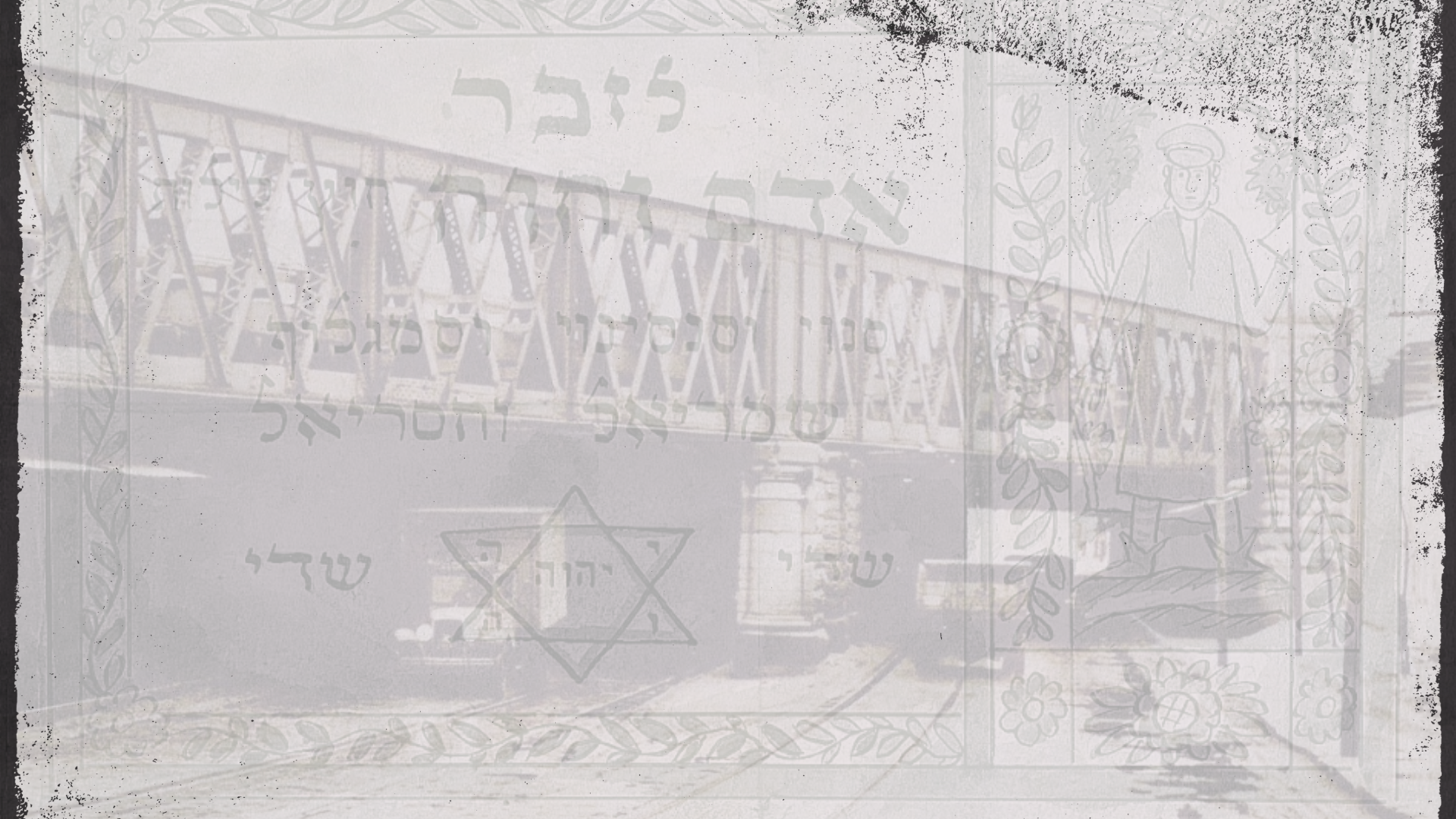
Many, many years ago my grandmother, Jessie, told me a story. After she gave birth to my father, she became very ill, and stayed in a hospital for a long time. Everyone thought she was going to die. Her father, Louis Sacofsky, came to visit her on her sickbed. According to Jessie, her father prayed for her, and in his prayers he begged God to take his life and let his daughter live.
When he left the hospital, he was promptly hit by a train, dying instantly. She miraculously recovered.
My family during this time were observant Jews from the old country, filled with religious belief and practice, and at times, to my mind, tainted with superstition. When she told me this tale, I was skeptical and didn't take it seriously. My grandmother provided no details, so I was left to imagine a dreamlike sequence of events, conjuring images of this old man with a full white beard leaving the hospital and, somewhere on an abandoned stretch of railway track, was struck down by a train. It seemed to be quite a stretch and I don’t remember anyone in the family ever talking about it. My father, who was only one years old when this supposedly happened, never knew his grandfather, so this story must have been as abstract for him as it was for me.
Some fifty years later, I discovered through an old newspaper article (which my sister received from an ancestry service) that the story was not only true but remains a chilling mystery.
On the morning of July 12, 1921, Ben Weinkofsky, Jessie’s brother-in-law, walked to the Bridgeport Railway Station to see if he could get any information about his father-in-law, who had not returned home from a trip to New York City the day before. The ticket agent called their supervisor. To Ben’s surprise, he was given the name of a Detective Williams and told to visit the police station.
At the station, Detective Williams was called to the front desk and took Ben to his office. Ben explained that his father-in-law, Louis Sacofsky, was missing. His wife had been expecting him for dinner, but he never arrived. After giving background details and a physical description, Ben was informed of a terrible accident that night involving a man of a similar profile, but they could not identify the victim.
“We don't know if this individual is related to you in any way,” said the detective, “but from your description it might be possible. He was struck down by the New Haven train on the King Street Viaduct just outside of Stratford. Was there any reason for your father-in-law to be in Stratford last night?”
“No, he was expected home here in Bridgeport returning from New York. He did not go to Stratford.”
“Well, perhaps it’s not your father-in-law,” said the detective. “The body was badly mutilated and there was nothing on his person to identify him. But we found this note in the outside breast pocket of his blazer. Does this mean anything to you?”
Ben looked at the handwritten note. Initially, he was confused but suddenly caught his breath, turned white, dropped down on the chair, and gasped, “Oy gotenyu!”
“What is it?” said Williams.
To himself, desperately: “No, no! ” He went silent, then muttered quietly, “This is the address of the hospital where his daughter is in New York. He went there yesterday to visit her.”
When Ben arrived home he was still as white as a sheet. His wife, Lillian, her mother, Rose, and her brothers Harry, Harris, and Samuel were waiting for him. He walked to where Lillian was sitting, knelt, took her hands and said “Tate ist toyt,” as tears filled his eyes. There was a terrible accident.
This was a horrible shock. Louis Sacofsky was the central figure in all their lives. He was the founder and owner of the clothing company where they all worked, he owned the apartment where they all lived, and he was the one who had brought the entire family—wife and five children—out of Czarist Russia, across Europe, and over the ocean to America. That was twenty-five years ago. It was inconceivable that this man was gone. The loss to the family was devastating.
Funeral arrangements were made quickly. However, in addition to the loss, there was unsettling confusion within the family concerning the circumstances surrounding the father’s death. No one could understand what he was doing on a train trestle in Stratford.
When they heard that the Fairfield County coroner was going to investigate the incident, the family acquired legal representation from attorneys Israel Cohen and James Shannon. Unfortunately, the coroner’s investigation focused mainly on the liability and possible negligence of the railroad and railroad personnel. The coroner found the incident to be an accident with neither individual nor company negligence. The authorities, as a result of the inquest, unfortunately, were unable to determine how Louis Sacofsky came to be on the train tracks of the King Street Viaduct at 9:30 p.m. on July 11, 1921.
Family members hypothesized that he had fallen asleep and missed his stop at Bridgeport, then woke up and jumped off the train as it slowed between stations, thinking to walk back.
But there was no proof or witness to support this theory. In fact, railroad personnel had testified specifically that the train had not slowed down before reaching Stratford. Further, the night watchman stationed at the bridge swore that no one had attempted to cross on foot that night or any other night. And yet, as the engineer of the New Haven express train stated, he’d seen the victim about 100 feet ahead of him, standing on the side of the track on the King Street Viaduct. He’d sounded the alarm, applied the emergency brake, but it was not physically possible to bring the tremendous weight of the engine and nine cars to a halt. The engineer saw the last moment of the victim’s life as he raised one arm as if to shield himself from the impact.
As part of the coroner’s investigation, an effort had been made to confirm that Louis Sacofsky had indeed been a passenger on the train from New York to Bridgeport. A wiry, dark-haired gentleman named Wagner confirmed this finding because he’d been standing in the ticket line directly behind Sacofsky at Grand Central Station. He said he knew Sacofsky because he was once a tenant of his. Wagner stated that Sacofsky asked the ticket agent when the next train to Bridgeport was leaving. The agent replied, “There’s one leaving now,” and Sacofsky made his way directly to the platform with Wagner close behind. Wagner saw Sacofsky seated in the last car as he walked past him.
The only other witnesses who might have seen Sacofsky in Stratford were the two young ladies on the Stratford platform. These were the Hamilton sisters, but they were never called to testify. There did not seem to be any explanation for his presence on that viaduct. No one had seen him leave the train, the train had never slowed to let him off, and no one had seen him step onto the tracks.
Louis Sacofsky had breakfast with his wife Rose on Monday morning before catching the 9:05 a.m. train to New York. They had talked about his trip as a last hope for their daughter who had become dangerously ill and hospitalized for many months after giving birth to their grandson. Louis had withdrawn $300 as a gift to a scholarly Jewish organization, which was part of the Kabbalah ritual that he planned to perform with a special rabbi that day to help heal his daughter.
But Rose was worried. “Sometimes terrible unexpected outcomes happen,” she said.
“Maybe” said Louis. “But this could be our last hope. Think of the miracles that Reb Mendel has brought forth in the past. He once saved a whole village by dreaming about the storm to come. I will talk to the rabbi today and hope he can do something for us. We are good people, Rose, so is Jessie, and the baby is an innocent who deserves to have a mother. Let us have faith.”
Louis spent an hour with Rabbi Mendel, then left his study on Hester Street to make his way to People’s Hospital, some twenty blocks north on 2nd Avenue, where his daughter was being treated for childbed fever (what the doctors called puerperal sepsis) and did not have a positive prognosis. She’d been in bed for eleven months, was very ill, and many people thought she would die. Louis was not quite ready to accept this diagnosis, and was prepared to go to great lengths to do whatever was humanly, or spiritually, possible to save his daughter’s life. She was only twenty-seven and had just given them a new grandson, Milton. And it was a sin that the little baby should be made an orphan. He refused to accept that this was the Lord’s will. Before heading uptown, he stopped at the shop Z. Rosenthal’s to buy a prayer candle, just as the rabbi had told him to do. He planned to walk the whole way to the hospital. The day felt holy, and just as he would on the Sabbath, he wanted to walk to his destination on foot. It was a hot July day. He stopped for a moment under a tree when the heat became oppressive. He took the note out of his jacket pocket and double-checked the address—yes, between 11th and 12th Streets. He was very near.
When he entered his daughter’s hospital room, she was in bed sleeping. He bent over and kissed her forehead and said, “Oy mayn klynikeh Yessele.” He looked deeply and affectionately at her face. Then, after a moment, he sat on the chair next to her bed. The room was very quiet; they were alone. Louis seemed to fall in to deep, concentrated thought. His mind was actively engaged—a world of stories were running through his head. At one point a smile lit up his face; at another moment his eyes gently filled with tears. And then he slowly shook his head from side to side.
Finally, he rose and went to the wash basin at the far end of the room to wash his hands and pat cold water on his face. After drying off, he walked back to the table near the bed. Out of his pocket he placed a tissue-paper wrapping onto the table and carefully unfolded it. Inside the wrapping was a piece of parchment paper and a small leather kame’a that the rabbi had specially prepared for him. He carried it over to the bed and tenderly slid the kame’a under Jessie’s pillow. While doing so, he said in Hebrew: Yehi kame’a zeh, chatum b’shemot kedoshim, l’magen al nishmata u’gufah.
May this kame’a, sealed with holy names, be as a shield for her soul and body.
He went back to the table and lit the candle, picked up the parchment paper, and chanted aloud, three times, the prayer which the rabbi had penned for him.
רִבּוֹנוֹ שֶׁל עוֹלָם
Master of the Universe,
אָנָּא, בְּרַחֲמֶיךָ הָרַבִּים, הָשֵׁב חַיִּים וּבְרִיאוּת לְיִסְכָּה בַּת פְרוֹמֶה.
Please, in Your great mercy, return life and health to Yiskah bat Fromme.
שְׁלַח לָהּ רְפוּאָה שְׁלֵמָה מֵהַשָּׁמַיִם – רְפוּאַת הַנֶּפֶשׁ וּרְפוּאַת הַגּוּף.
Send her a complete healing from Heaven—healing of the soul and healing of the body.
יְהִי רָצוֹן מִלְּפָנֶיךָ שֶׁיִּהְיוּ דִּמְעוֹתַי לְפָנֶיךָ כְּקָטֶרֶת טְהוֹרָה.
May it be Your will that my tears rise before You like pure incense.
אִם גּוֹזֵר אַתָּה דִּין – קַח אֶת נַפְשִׁי וְהַנַּח לָהּ לִחְיוֹת.
If You have decreed judgment—take my soul, and let hers remain.
בַּעֲבוּר אַהֲבַת אָב לְבִתּוֹ, תְּקַבֵּל תְּחִנָּתִי בְּרַחֲמִים גְּדוֹלִים.
For the love of a father for his daughter, accept my plea with great compassion.
אָמֵן.
Amen.
The Rabbi had said, “Three times you must call upon the Holy One—once for her body, once for her soul, once for her child.” Then he sat back in the chair with tears in his eyes and spoke in Yiddish with deep conviction. The words burst out of him three times.
Nim mayn neshome, un loz ir zeyer blaybn.
Nim mayn neshome, un loz ir zeyer blaybn.
Nim mayn neshome, un loz ir zeyer blaybn.
“Take my soul, and let hers remain.”
At this point Jessie awoke, hearing what her father was saying, and understood his prayer. But he left the room not knowing she was conscious.
On the street he was beside himself. He felt a tremendous desire to be home with Rose. He saw a taxi and jumped in. At Grand Central, he went hurriedly to the ticket counter and asked when the next train to Bridgeport was leaving. “There’s one departing now that you can get,” the agent said. He walked quickly to the platform, not noticing the tall, thin man with the black, greasy hair following behind him—the one who had stood behind him at the ticket counter.
He entered the train in the last car and took a seat; the train was empty. Just at that moment a man came from behind turned toward and said “We’re going the same way.” The man’s eyes were shining, and his smile was one of total contentment—all of which seemed completely out of place. Louis was speechless, and the man turned and continued walking ahead into the next car. Immediately, Louis closed his eyes and fell into a deep sleep.
He dreamt he saw the face of the strange man with the shining eyes emerge from the sky, surrounded by a white cloud, smiling gently and waving him forward. As if floating through the air, Louis sees his entire family on a beach at the water’s edge—picnicking, singing, and playing games. And he, Louis, is in the midst of them, surrounded by their joy and happiness. In the distance, on a lush green meadow, Jessie is standing healthy and happy, holding her baby in her arms with her husband’s arms around them both. Then from the sky before him, two young women glide towards him—angels, who, without touching him, raise him up and carry him to a small river and place him in a basket, and he floats down the body of water. He feels, like never before, a lightness, a freedom, a great happiness. As if his whole life had great meaning and importance. A feeling of fullness and satisfaction, as if all necessities and duties in life were taken from him. He floated down the river in complete peace and harmony, with one hand raised in thanks to the Lord.
When he awoke, the train was pulling into Milford Station, which meant that he had missed his stop at Bridgeport and gone past Stratford. As he exited the train, he saw the New Haven line pulling out on the opposite platform. So his ride back to Bridgeport had just departed.
The timetable on the station wall indicated that the next train back was leaving in an hour and a half. The platform at Milford is ground level, so one could simply step directly onto the tracks and start walking. It didn’t seem particularly dangerous. If a train were to come, you could just hop off the track and stand on the grass. Louis decided that in an hour and a half he could reach Bridgeport on foot, and off he went.
After about an hour of walking, things were going fine, except he had not yet reached Stratford, the town before Bridgeport, although he could see the lights of the town in the distance. He was still feeling fairly fit, and the evening air was pleasantly cool, so he kept on going. But very soon he noticed that he was walking a bit higher off the ground than before, and realized that he was approaching a train trestle.
After another fifteen minutes he was about thirty feet above the street below and was walking on the King Street Viaduct. Here everything narrowed; there was no room on the side to stand if a train were to come by. In addition, walking itself became very difficult and dangerous—he could no longer get a solid footing. He stopped and, looking around, was overcome by a sense of dread. There was no room for escape. The cold, unforgiving, massive industrial structure of the bridge terrified him. The only thing to do was to get off as soon as he could.
He decided to turn back as he wasn’t even a quarter of the way across. After only three steps he saw the headlights coming. Just at that moment his dream returned to him and he was floating down the river and realized everything had gone as planned. He raised his hand to thank the Lord.
Louis Sacofsky died that night on the King Street Viaduct. His daughter Jessie recovered, raised her son, had three grandchildren, and died at age eighty-seven.
Many, many years ago my grandmother, Jessie, told me a story. After she gave birth to my father, she became very ill, and stayed in a hospital for a long time. Everyone thought she was going to die. Her father, Louis Sacofsky, came to visit her on her sickbed. According to Jessie, her father prayed for her, and in his prayers he begged God to take his life and let his daughter live.
When he left the hospital, he was promptly hit by a train, dying instantly. She miraculously recovered.
My family during this time were observant Jews from the old country, filled with religious belief and practice, and at times, to my mind, tainted with superstition. When she told me this tale, I was skeptical and didn't take it seriously. My grandmother provided no details, so I was left to imagine a dreamlike sequence of events, conjuring images of this old man with a full white beard leaving the hospital and, somewhere on an abandoned stretch of railway track, was struck down by a train. It seemed to be quite a stretch and I don’t remember anyone in the family ever talking about it. My father, who was only one years old when this supposedly happened, never knew his grandfather, so this story must have been as abstract for him as it was for me.
Some fifty years later, I discovered through an old newspaper article (which my sister received from an ancestry service) that the story was not only true but remains a chilling mystery.
On the morning of July 12, 1921, Ben Weinkofsky, Jessie’s brother-in-law, walked to the Bridgeport Railway Station to see if he could get any information about his father-in-law, who had not returned home from a trip to New York City the day before. The ticket agent called their supervisor. To Ben’s surprise, he was given the name of a Detective Williams and told to visit the police station.
At the station, Detective Williams was called to the front desk and took Ben to his office. Ben explained that his father-in-law, Louis Sacofsky, was missing. His wife had been expecting him for dinner, but he never arrived. After giving background details and a physical description, Ben was informed of a terrible accident that night involving a man of a similar profile, but they could not identify the victim.
“We don't know if this individual is related to you in any way,” said the detective, “but from your description it might be possible. He was struck down by the New Haven train on the King Street Viaduct just outside of Stratford. Was there any reason for your father-in-law to be in Stratford last night?”
“No, he was expected home here in Bridgeport returning from New York. He did not go to Stratford.”
“Well, perhaps it’s not your father-in-law,” said the detective. “The body was badly mutilated and there was nothing on his person to identify him. But we found this note in the outside breast pocket of his blazer. Does this mean anything to you?”
Ben looked at the handwritten note. Initially, he was confused but suddenly caught his breath, turned white, dropped down on the chair, and gasped, “Oy gotenyu!”
“What is it?” said Williams.
To himself, desperately: “No, no! ” He went silent, then muttered quietly, “This is the address of the hospital where his daughter is in New York. He went there yesterday to visit her.”
When Ben arrived home he was still as white as a sheet. His wife, Lillian, her mother, Rose, and her brothers Harry, Harris, and Samuel were waiting for him. He walked to where Lillian was sitting, knelt, took her hands and said “Tate ist toyt,” as tears filled his eyes. There was a terrible accident.
This was a horrible shock. Louis Sacofsky was the central figure in all their lives. He was the founder and owner of the clothing company where they all worked, he owned the apartment where they all lived, and he was the one who had brought the entire family—wife and five children—out of Czarist Russia, across Europe, and over the ocean to America. That was twenty-five years ago. It was inconceivable that this man was gone. The loss to the family was devastating.
Funeral arrangements were made quickly. However, in addition to the loss, there was unsettling confusion within the family concerning the circumstances surrounding the father’s death. No one could understand what he was doing on a train trestle in Stratford.
When they heard that the Fairfield County coroner was going to investigate the incident, the family acquired legal representation from attorneys Israel Cohen and James Shannon. Unfortunately, the coroner’s investigation focused mainly on the liability and possible negligence of the railroad and railroad personnel. The coroner found the incident to be an accident with neither individual nor company negligence. The authorities, as a result of the inquest, unfortunately, were unable to determine how Louis Sacofsky came to be on the train tracks of the King Street Viaduct at 9:30 p.m. on July 11, 1921.
Family members hypothesized that he had fallen asleep and missed his stop at Bridgeport, then woke up and jumped off the train as it slowed between stations, thinking to walk back.
But there was no proof or witness to support this theory. In fact, railroad personnel had testified specifically that the train had not slowed down before reaching Stratford. Further, the night watchman stationed at the bridge swore that no one had attempted to cross on foot that night or any other night. And yet, as the engineer of the New Haven express train stated, he’d seen the victim about 100 feet ahead of him, standing on the side of the track on the King Street Viaduct. He’d sounded the alarm, applied the emergency brake, but it was not physically possible to bring the tremendous weight of the engine and nine cars to a halt. The engineer saw the last moment of the victim’s life as he raised one arm as if to shield himself from the impact.
As part of the coroner’s investigation, an effort had been made to confirm that Louis Sacofsky had indeed been a passenger on the train from New York to Bridgeport. A wiry, dark-haired gentleman named Wagner confirmed this finding because he’d been standing in the ticket line directly behind Sacofsky at Grand Central Station. He said he knew Sacofsky because he was once a tenant of his. Wagner stated that Sacofsky asked the ticket agent when the next train to Bridgeport was leaving. The agent replied, “There’s one leaving now,” and Sacofsky made his way directly to the platform with Wagner close behind. Wagner saw Sacofsky seated in the last car as he walked past him.
The only other witnesses who might have seen Sacofsky in Stratford were the two young ladies on the Stratford platform. These were the Hamilton sisters, but they were never called to testify. There did not seem to be any explanation for his presence on that viaduct. No one had seen him leave the train, the train had never slowed to let him off, and no one had seen him step onto the tracks.
Louis Sacofsky had breakfast with his wife Rose on Monday morning before catching the 9:05 a.m. train to New York. They had talked about his trip as a last hope for their daughter who had become dangerously ill and hospitalized for many months after giving birth to their grandson. Louis had withdrawn $300 as a gift to a scholarly Jewish organization, which was part of the Kabbalah ritual that he planned to perform with a special rabbi that day to help heal his daughter.
But Rose was worried. “Sometimes terrible unexpected outcomes happen,” she said.
“Maybe” said Louis. “But this could be our last hope. Think of the miracles that Reb Mendel has brought forth in the past. He once saved a whole village by dreaming about the storm to come. I will talk to the rabbi today and hope he can do something for us. We are good people, Rose, so is Jessie, and the baby is an innocent who deserves to have a mother. Let us have faith.”
Louis spent an hour with Rabbi Mendel, then left his study on Hester Street to make his way to People’s Hospital, some twenty blocks north on 2nd Avenue, where his daughter was being treated for childbed fever (what the doctors called puerperal sepsis) and did not have a positive prognosis. She’d been in bed for eleven months, was very ill, and many people thought she would die. Louis was not quite ready to accept this diagnosis, and was prepared to go to great lengths to do whatever was humanly, or spiritually, possible to save his daughter’s life. She was only twenty-seven and had just given them a new grandson, Milton. And it was a sin that the little baby should be made an orphan. He refused to accept that this was the Lord’s will. Before heading uptown, he stopped at the shop Z. Rosenthal’s to buy a prayer candle, just as the rabbi had told him to do. He planned to walk the whole way to the hospital. The day felt holy, and just as he would on the Sabbath, he wanted to walk to his destination on foot. It was a hot July day. He stopped for a moment under a tree when the heat became oppressive. He took the note out of his jacket pocket and double-checked the address—yes, between 11th and 12th Streets. He was very near.
When he entered his daughter’s hospital room, she was in bed sleeping. He bent over and kissed her forehead and said, “Oy mayn klynikeh Yessele.” He looked deeply and affectionately at her face. Then, after a moment, he sat on the chair next to her bed. The room was very quiet; they were alone. Louis seemed to fall in to deep, concentrated thought. His mind was actively engaged—a world of stories were running through his head. At one point a smile lit up his face; at another moment his eyes gently filled with tears. And then he slowly shook his head from side to side.
Finally, he rose and went to the wash basin at the far end of the room to wash his hands and pat cold water on his face. After drying off, he walked back to the table near the bed. Out of his pocket he placed a tissue-paper wrapping onto the table and carefully unfolded it. Inside the wrapping was a piece of parchment paper and a small leather kame’a that the rabbi had specially prepared for him. He carried it over to the bed and tenderly slid the kame’a under Jessie’s pillow. While doing so, he said in Hebrew: Yehi kame’a zeh, chatum b’shemot kedoshim, l’magen al nishmata u’gufah.
May this kame’a, sealed with holy names, be as a shield for her soul and body.
He went back to the table and lit the candle, picked up the parchment paper, and chanted aloud, three times, the prayer which the rabbi had penned for him.
רִבּוֹנוֹ שֶׁל עוֹלָם
Master of the Universe,
אָנָּא, בְּרַחֲמֶיךָ הָרַבִּים, הָשֵׁב חַיִּים וּבְרִיאוּת לְיִסְכָּה בַּת פְרוֹמֶה.
Please, in Your great mercy, return life and health to Yiskah bat Fromme.
שְׁלַח לָהּ רְפוּאָה שְׁלֵמָה מֵהַשָּׁמַיִם – רְפוּאַת הַנֶּפֶשׁ וּרְפוּאַת הַגּוּף.
Send her a complete healing from Heaven—healing of the soul and healing of the body.
יְהִי רָצוֹן מִלְּפָנֶיךָ שֶׁיִּהְיוּ דִּמְעוֹתַי לְפָנֶיךָ כְּקָטֶרֶת טְהוֹרָה.
May it be Your will that my tears rise before You like pure incense.
אִם גּוֹזֵר אַתָּה דִּין – קַח אֶת נַפְשִׁי וְהַנַּח לָהּ לִחְיוֹת.
If You have decreed judgment—take my soul, and let hers remain.
בַּעֲבוּר אַהֲבַת אָב לְבִתּוֹ, תְּקַבֵּל תְּחִנָּתִי בְּרַחֲמִים גְּדוֹלִים.
For the love of a father for his daughter, accept my plea with great compassion.
אָמֵן.
Amen.
The Rabbi had said, “Three times you must call upon the Holy One—once for her body, once for her soul, once for her child.” Then he sat back in the chair with tears in his eyes and spoke in Yiddish with deep conviction. The words burst out of him three times.
Nim mayn neshome, un loz ir zeyer blaybn.
Nim mayn neshome, un loz ir zeyer blaybn.
Nim mayn neshome, un loz ir zeyer blaybn.
“Take my soul, and let hers remain.”
At this point Jessie awoke, hearing what her father was saying, and understood his prayer. But he left the room not knowing she was conscious.
On the street he was beside himself. He felt a tremendous desire to be home with Rose. He saw a taxi and jumped in. At Grand Central, he went hurriedly to the ticket counter and asked when the next train to Bridgeport was leaving. “There’s one departing now that you can get,” the agent said. He walked quickly to the platform, not noticing the tall, thin man with the black, greasy hair following behind him—the one who had stood behind him at the ticket counter.
He entered the train in the last car and took a seat; the train was empty. Just at that moment a man came from behind turned toward and said “We’re going the same way.” The man’s eyes were shining, and his smile was one of total contentment—all of which seemed completely out of place. Louis was speechless, and the man turned and continued walking ahead into the next car. Immediately, Louis closed his eyes and fell into a deep sleep.
He dreamt he saw the face of the strange man with the shining eyes emerge from the sky, surrounded by a white cloud, smiling gently and waving him forward. As if floating through the air, Louis sees his entire family on a beach at the water’s edge—picnicking, singing, and playing games. And he, Louis, is in the midst of them, surrounded by their joy and happiness. In the distance, on a lush green meadow, Jessie is standing healthy and happy, holding her baby in her arms with her husband’s arms around them both. Then from the sky before him, two young women glide towards him—angels, who, without touching him, raise him up and carry him to a small river and place him in a basket, and he floats down the body of water. He feels, like never before, a lightness, a freedom, a great happiness. As if his whole life had great meaning and importance. A feeling of fullness and satisfaction, as if all necessities and duties in life were taken from him. He floated down the river in complete peace and harmony, with one hand raised in thanks to the Lord.
When he awoke, the train was pulling into Milford Station, which meant that he had missed his stop at Bridgeport and gone past Stratford. As he exited the train, he saw the New Haven line pulling out on the opposite platform. So his ride back to Bridgeport had just departed.
The timetable on the station wall indicated that the next train back was leaving in an hour and a half. The platform at Milford is ground level, so one could simply step directly onto the tracks and start walking. It didn’t seem particularly dangerous. If a train were to come, you could just hop off the track and stand on the grass. Louis decided that in an hour and a half he could reach Bridgeport on foot, and off he went.
After about an hour of walking, things were going fine, except he had not yet reached Stratford, the town before Bridgeport, although he could see the lights of the town in the distance. He was still feeling fairly fit, and the evening air was pleasantly cool, so he kept on going. But very soon he noticed that he was walking a bit higher off the ground than before, and realized that he was approaching a train trestle.
After another fifteen minutes he was about thirty feet above the street below and was walking on the King Street Viaduct. Here everything narrowed; there was no room on the side to stand if a train were to come by. In addition, walking itself became very difficult and dangerous—he could no longer get a solid footing. He stopped and, looking around, was overcome by a sense of dread. There was no room for escape. The cold, unforgiving, massive industrial structure of the bridge terrified him. The only thing to do was to get off as soon as he could.
He decided to turn back as he wasn’t even a quarter of the way across. After only three steps he saw the headlights coming. Just at that moment his dream returned to him and he was floating down the river and realized everything had gone as planned. He raised his hand to thank the Lord.
Louis Sacofsky died that night on the King Street Viaduct. His daughter Jessie recovered, raised her son, had three grandchildren, and died at age eighty-seven.