


Are snacks that taste like dead fish or centipedes kosher?
It depends how you define kosher.
An education at a Friday night meal:
A typical Shabbat with some friends; a Haredi family in Lakewood, New Jersey. We typically eat Ashkenazi fare—chicken soup, potato kugel, and delicious homemade challah.
Then, over dessert, it became atypical. The kids offered me a small bag of jelly beans. The contents’ flavours were listed on the outside of the bag, including licorice, banana, peach, wet dog, old bandage, and stink bug.
That was when I learned about BeanBoozled jelly beans. A creation of California-based Jelly Belly Candy Corporation.
The jelly beans are pareve, kosher, and the bag they are nestled in bears the OU hashgacha mark. This year the company unveils the eighth edition of BeanBoozled, which will, no doubt, continue to offer a mix of standard and decidedly nonstandard flavours.
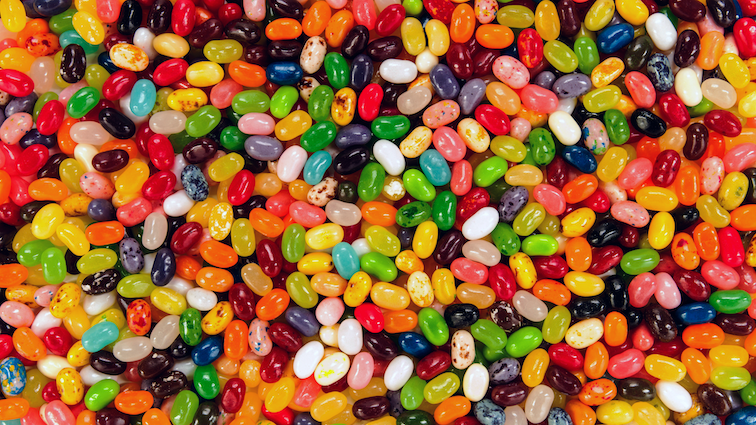
Here’s the chiddush: you can’t tell which are which by looking at an identically coloured pair of jelly beans like juicy pear or booger, top banana or pencil shavings, lime or lawn clippings. It’s a gastronomic dare—when you take a bite, will you say “yum!” or “yuck!”?
The BeanBoozled jelly beans come in flavours that range from the relatively innocuous (like black pepper or toothpaste) to the truly awful (like rotten egg or barf).
I learned from my friends in Lakewood that in some Orthodox circles these candies are popular especially with young children who have approving parents. BeanBoozled has a big enough following in Orthodox neighbourhoods to qualify as a contemporary Jewish trend.
Why do people eat them, knowing that an unpleasant experience is likely in store? They’re fun, a controlled challenge, a norm breaker, a quick thrill.
The online conversation platform Quora.com helpfully points out that BeanBoozleds are “safe to eat. There are no authentic ‘natural’ ingredients used in creating these jelly beans, i.e. there are no actual boogers in the booger jelly beans. They are all made with a concoction of edible chemicals to match those of the real thing.”
An estimated 250–400 million BeanBoozleds have been eaten since their launch in 2007; they were reportedly inspired by Bertie Bott’s Every Flavour Beans that were popular among the students at Hogwarts School of Witchcraft and Wizardry.
Here’s how it works: the little bags are marked with the choice of chromatic possibilities inside. Dark brown can be cappuccino or liver & onions. Also dark brown can be chocolate pudding or canned dog food. Light brown can be toasted marshmallow or stink bug.
Just as chazal say that one’s attitude about eating something treif should be, “It’s probably delicious, but I’m not allowed to eat it,” one may think about BeanBoozleds, “I know they’re probably gross—so for that reason, ‘No thanks.’”
BeanBoozleds’ apparent popularity in frum circles raises a question—what would the sages say about them? Chazal set down some general principles of wise conduct. Eschew discomfort that has no meaning, concentrate on eating food that is healthful:
- Repulsion should be avoided as much as real harm (Ketubot 61:a).
- Disgust is a reason to prohibit consumption, even if there is not a clear danger (Avodah Zarah 30:a).
- “Since maintaining a healthy and sound body is among the ways of God . . . a person should never eat unless he is hungry . . . There are foods that are extremely harmful [or] produce an odour . . . or a very bitter taste. One should never eat them. They are like poison to the body.” (Rambam, Hilchot De’ot 4:1–9)
Does eating the jelly beans lead to spiritual growth?
Some other questions arise:
- How do you define “kosher”? A product that simply contains no forbidden ingredients, or was not produced in a non-kosher vessel, or one that violates common sense or good taste (in the realm of etiquette)?
- Is this a smart use of the food industry’s highest level of state-of-the-art technology? An incredibly sophisticated, intricate knowledge of chemical additives goes into the making of ersatz flavours that closely approximate an actual flavour. The expert chemists duplicate the undesirable food’s smell (analyzed in a gas chromatograph), which reinforces its pungency.
- What sort of creative mind comes up with these possible flavours in the first place? You have to have an active imagination to think that people want to eat something that tastes like dirty dishwater.
- Finally, was this idea, or these flavours, tested with a focus group? Did a bunch of consumers tell the jelly bean people that some of the firm’s products, that make you believe a baby wipe is in your mouth, would be profitable?
BeanBoozleds sell. But not to me. Even if they’re kosher.
I don’t berate my friends in Lakewood for offering me some probably unattractive jelly beans at their meals. The kids get a kick out of it. But I’ll stick to potato kugel, chicken soup, and delicious homemade challah.
Are snacks that taste like dead fish or centipedes kosher?
It depends how you define kosher.
An education at a Friday night meal:
A typical Shabbat with some friends; a Haredi family in Lakewood, New Jersey. We typically eat Ashkenazi fare—chicken soup, potato kugel, and delicious homemade challah.
Then, over dessert, it became atypical. The kids offered me a small bag of jelly beans. The contents’ flavours were listed on the outside of the bag, including licorice, banana, peach, wet dog, old bandage, and stink bug.
That was when I learned about BeanBoozled jelly beans. A creation of California-based Jelly Belly Candy Corporation.
The jelly beans are pareve, kosher, and the bag they are nestled in bears the OU hashgacha mark. This year the company unveils the eighth edition of BeanBoozled, which will, no doubt, continue to offer a mix of standard and decidedly nonstandard flavours.
Here’s the chiddush: you can’t tell which are which by looking at an identically coloured pair of jelly beans like juicy pear or booger, top banana or pencil shavings, lime or lawn clippings. It’s a gastronomic dare—when you take a bite, will you say “yum!” or “yuck!”?
The BeanBoozled jelly beans come in flavours that range from the relatively innocuous (like black pepper or toothpaste) to the truly awful (like rotten egg or barf).
I learned from my friends in Lakewood that in some Orthodox circles these candies are popular especially with young children who have approving parents. BeanBoozled has a big enough following in Orthodox neighbourhoods to qualify as a contemporary Jewish trend.
Why do people eat them, knowing that an unpleasant experience is likely in store? They’re fun, a controlled challenge, a norm breaker, a quick thrill.
The online conversation platform Quora.com helpfully points out that BeanBoozleds are “safe to eat. There are no authentic ‘natural’ ingredients used in creating these jelly beans, i.e. there are no actual boogers in the booger jelly beans. They are all made with a concoction of edible chemicals to match those of the real thing.”
An estimated 250–400 million BeanBoozleds have been eaten since their launch in 2007; they were reportedly inspired by Bertie Bott’s Every Flavour Beans that were popular among the students at Hogwarts School of Witchcraft and Wizardry.
Here’s how it works: the little bags are marked with the choice of chromatic possibilities inside. Dark brown can be cappuccino or liver & onions. Also dark brown can be chocolate pudding or canned dog food. Light brown can be toasted marshmallow or stink bug.
Just as chazal say that one’s attitude about eating something treif should be, “It’s probably delicious, but I’m not allowed to eat it,” one may think about BeanBoozleds, “I know they’re probably gross—so for that reason, ‘No thanks.’”
BeanBoozleds’ apparent popularity in frum circles raises a question—what would the sages say about them? Chazal set down some general principles of wise conduct. Eschew discomfort that has no meaning, concentrate on eating food that is healthful:
- Repulsion should be avoided as much as real harm (Ketubot 61:a).
- Disgust is a reason to prohibit consumption, even if there is not a clear danger (Avodah Zarah 30:a).
- “Since maintaining a healthy and sound body is among the ways of God . . . a person should never eat unless he is hungry . . . There are foods that are extremely harmful [or] produce an odour . . . or a very bitter taste. One should never eat them. They are like poison to the body.” (Rambam, Hilchot De’ot 4:1–9)
Does eating the jelly beans lead to spiritual growth?
Some other questions arise:
- How do you define “kosher”? A product that simply contains no forbidden ingredients, or was not produced in a non-kosher vessel, or one that violates common sense or good taste (in the realm of etiquette)?
- Is this a smart use of the food industry’s highest level of state-of-the-art technology? An incredibly sophisticated, intricate knowledge of chemical additives goes into the making of ersatz flavours that closely approximate an actual flavour. The expert chemists duplicate the undesirable food’s smell (analyzed in a gas chromatograph), which reinforces its pungency.
- What sort of creative mind comes up with these possible flavours in the first place? You have to have an active imagination to think that people want to eat something that tastes like dirty dishwater.
- Finally, was this idea, or these flavours, tested with a focus group? Did a bunch of consumers tell the jelly bean people that some of the firm’s products, that make you believe a baby wipe is in your mouth, would be profitable?
BeanBoozleds sell. But not to me. Even if they’re kosher.
I don’t berate my friends in Lakewood for offering me some probably unattractive jelly beans at their meals. The kids get a kick out of it. But I’ll stick to potato kugel, chicken soup, and delicious homemade challah.