


I have always loved Passover—the smells, the sounds, the tastes. My favourite part is gathering my family around the table and leading the Seder. The magic of Passover lies in its domesticity. Each year, families and friends, including those who may not have practiced their Judaism all year, come together to tell the same story.
For the past two years I have designed my own Haggadah, highlighting the elements I find most meaningful, omitting others, and peppering photos of past Passovers throughout.
Rabbi Yossi Klein Halevi teaches that there are two types of Jews: Purim Jews and Passover Jews. Passover Jews read the Haggadah and draw the moral lesson: “Love the stranger, for we were strangers in the land of Egypt” (Deuteronomy 10:19). Purim Jews read the Megillah and draw a different conclusion: The world is dangerous. We must be vigilant.
I have always considered myself a Passover Jew. This year, after a frightening rise in antisemitism that saw Toronto synagogues shot into, an American preschool attacked, and a Belgian temple bombed, I am no longer sure.
For the Seder I led, I did something different this time around. I created a series called Modern Moseses, a collection of stories for each of our 14 guests to read aloud. These stories featured a diverse range of Jews and non-Jews who had escaped or helped others escape modern slavery.
They include Sithy Yi, who fled the Cambodian genocide as a child, helping her family survive starvation and mass killings under the Khmer Rouge only to be detained by ICE decades later; and Indigenous Canadian Bridget Perrier, who survived the child sex trade and has become an advocate against human trafficking in Toronto.
I also honour figures from the Holocaust: Nicholas Winton, who rescued 669 children from Czechoslovakia; Irena Sendler, who smuggled 2,500 children out of the Warsaw Ghetto; Aleksander Pechersky, who organized a revolt at Sobibor extermination camp; and Mira Fuchrer, a leader of the Warsaw Ghetto Uprising.
Later in the evening, we opened the door for Elijah, recalling historian Shalom Ben-Chorin’s assertion that medieval Jews did so, in part, to ensure an infant corpse had not been planted in their doorway as part of a blood libel.
We closed the door, sang our concluding songs, and then, the doorbell rang.
Three young men stood outside, having taken a few polite steps back to show they meant no harm. They were tourists, confused by Toronto’s arcane temporary permit system. My mom welcomed them in from the cold. We offered to print their permit and invited them to sit and share some flourless cake.
“Where are you from?” I asked as I headed upstairs to fetch their document.
“Germany.”
I froze. Around the table, the Jews burst into uncontrollable laughter.
“We are celebrating Passover,” my cousin Lior explained, pulling up three chairs for our guests.
They didn’t recognize the word.
“Where in Germany?” he asked.
“Nuremberg,” one replied, “have you heard of it?”
“As a matter of fact,” Lior said, “I have.”
Some of us were curious, why this house? We were the only ones with lights on at 11 p.m., they explained. I found myself oddly comforted by the fact that my mother had always been too nervous to hang a mezuzah.
I grew up attending Jewish day school and learned about the horrors of the Holocaust at a young age. I had the privilege of believing it could never happen again. I wondered whether Johannes, Tömas, and Felix had come by our house before 2023, if I would have found the moment as unsettling, or as darkly humorous, as I did now. I thought of my time in Berlin 11 years ago and the amazing people I met there. I never conflated them with the history I had studied.
The ancient Israelites whose liberation we celebrate at Passover were not naive. They knew that survival required vigilance. And yet, as they fled Egypt, they welcomed Erev Rav—a “mixed multitude” of non-Israelites—into their midst. In other words, they were Passover and Purim Jews.
The philosopher Adi Ophir offers another interpretation of opening the door for Eliyahu. Like Ben-Chorin, he sees a darker history behind the ritual, but not one of fear. Rather, he understands it as defiance, a way for Jews to prove, to themselves and to others, that they were not afraid.
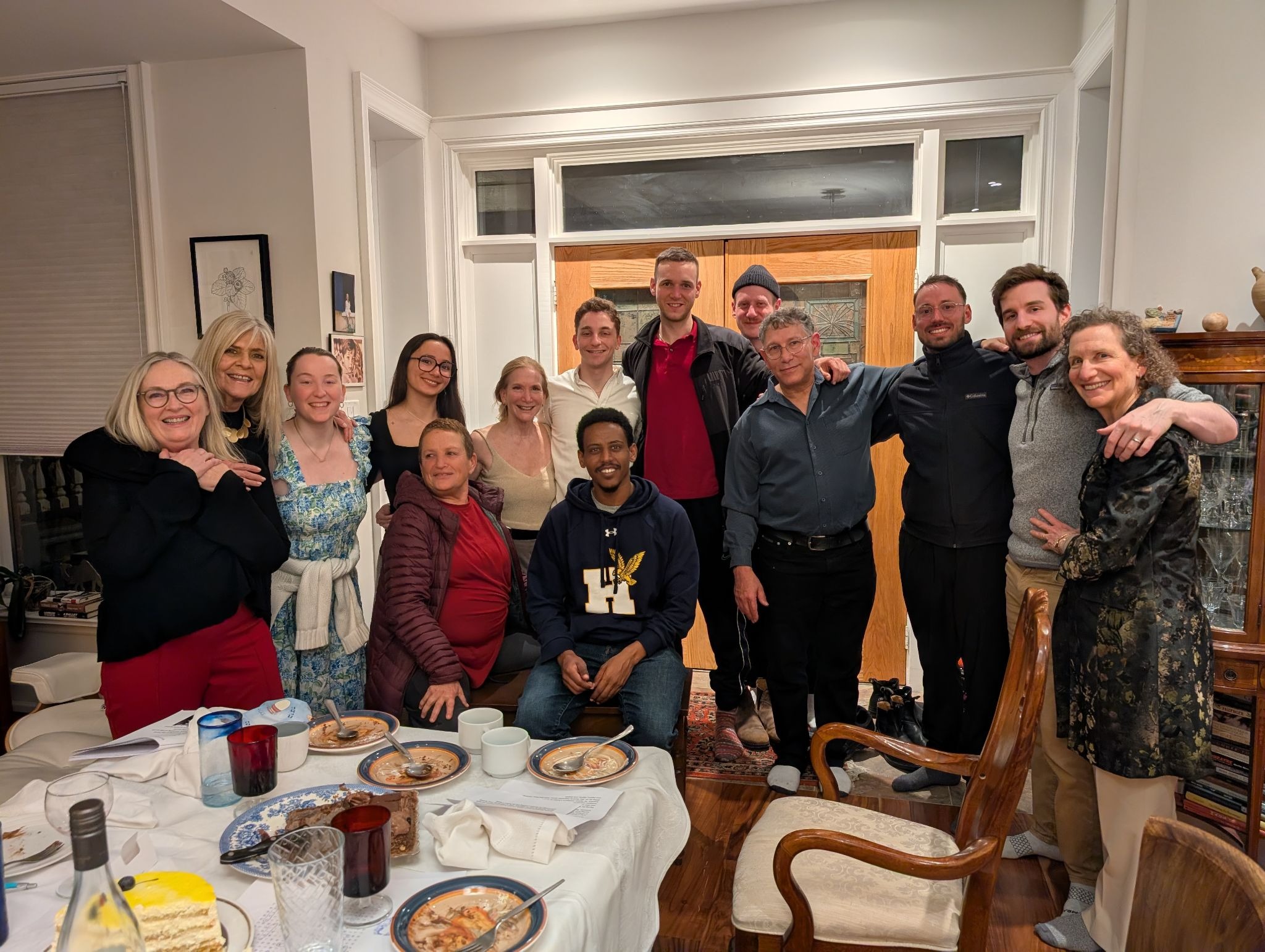
We may have hesitated when our unexpected guests turned up at our door. But by the end of the night, everyone was eager to take a photo together.
I am proud that we didn’t let fear override our Canadian-Jewish instinct to welcome the stranger.
I have always loved Passover—the smells, the sounds, the tastes. My favourite part is gathering my family around the table and leading the Seder. The magic of Passover lies in its domesticity. Each year, families and friends, including those who may not have practiced their Judaism all year, come together to tell the same story.
For the past two years I have designed my own Haggadah, highlighting the elements I find most meaningful, omitting others, and peppering photos of past Passovers throughout.
Rabbi Yossi Klein Halevi teaches that there are two types of Jews: Purim Jews and Passover Jews. Passover Jews read the Haggadah and draw the moral lesson: “Love the stranger, for we were strangers in the land of Egypt” (Deuteronomy 10:19). Purim Jews read the Megillah and draw a different conclusion: The world is dangerous. We must be vigilant.
I have always considered myself a Passover Jew. This year, after a frightening rise in antisemitism that saw Toronto synagogues shot into, an American preschool attacked, and a Belgian temple bombed, I am no longer sure.
For the Seder I led, I did something different this time around. I created a series called Modern Moseses, a collection of stories for each of our 14 guests to read aloud. These stories featured a diverse range of Jews and non-Jews who had escaped or helped others escape modern slavery.
They include Sithy Yi, who fled the Cambodian genocide as a child, helping her family survive starvation and mass killings under the Khmer Rouge only to be detained by ICE decades later; and Indigenous Canadian Bridget Perrier, who survived the child sex trade and has become an advocate against human trafficking in Toronto.
I also honour figures from the Holocaust: Nicholas Winton, who rescued 669 children from Czechoslovakia; Irena Sendler, who smuggled 2,500 children out of the Warsaw Ghetto; Aleksander Pechersky, who organized a revolt at Sobibor extermination camp; and Mira Fuchrer, a leader of the Warsaw Ghetto Uprising.
Later in the evening, we opened the door for Elijah, recalling historian Shalom Ben-Chorin’s assertion that medieval Jews did so, in part, to ensure an infant corpse had not been planted in their doorway as part of a blood libel.
We closed the door, sang our concluding songs, and then, the doorbell rang.
Three young men stood outside, having taken a few polite steps back to show they meant no harm. They were tourists, confused by Toronto’s arcane temporary permit system. My mom welcomed them in from the cold. We offered to print their permit and invited them to sit and share some flourless cake.
“Where are you from?” I asked as I headed upstairs to fetch their document.
“Germany.”
I froze. Around the table, the Jews burst into uncontrollable laughter.
“We are celebrating Passover,” my cousin Lior explained, pulling up three chairs for our guests.
They didn’t recognize the word.
“Where in Germany?” he asked.
“Nuremberg,” one replied, “have you heard of it?”
“As a matter of fact,” Lior said, “I have.”
Some of us were curious, why this house? We were the only ones with lights on at 11 p.m., they explained. I found myself oddly comforted by the fact that my mother had always been too nervous to hang a mezuzah.
I grew up attending Jewish day school and learned about the horrors of the Holocaust at a young age. I had the privilege of believing it could never happen again. I wondered whether Johannes, Tömas, and Felix had come by our house before 2023, if I would have found the moment as unsettling, or as darkly humorous, as I did now. I thought of my time in Berlin 11 years ago and the amazing people I met there. I never conflated them with the history I had studied.
The ancient Israelites whose liberation we celebrate at Passover were not naive. They knew that survival required vigilance. And yet, as they fled Egypt, they welcomed Erev Rav—a “mixed multitude” of non-Israelites—into their midst. In other words, they were Passover and Purim Jews.
The philosopher Adi Ophir offers another interpretation of opening the door for Eliyahu. Like Ben-Chorin, he sees a darker history behind the ritual, but not one of fear. Rather, he understands it as defiance, a way for Jews to prove, to themselves and to others, that they were not afraid.
We may have hesitated when our unexpected guests turned up at our door. But by the end of the night, everyone was eager to take a photo together.
I am proud that we didn’t let fear override our Canadian-Jewish instinct to welcome the stranger.