



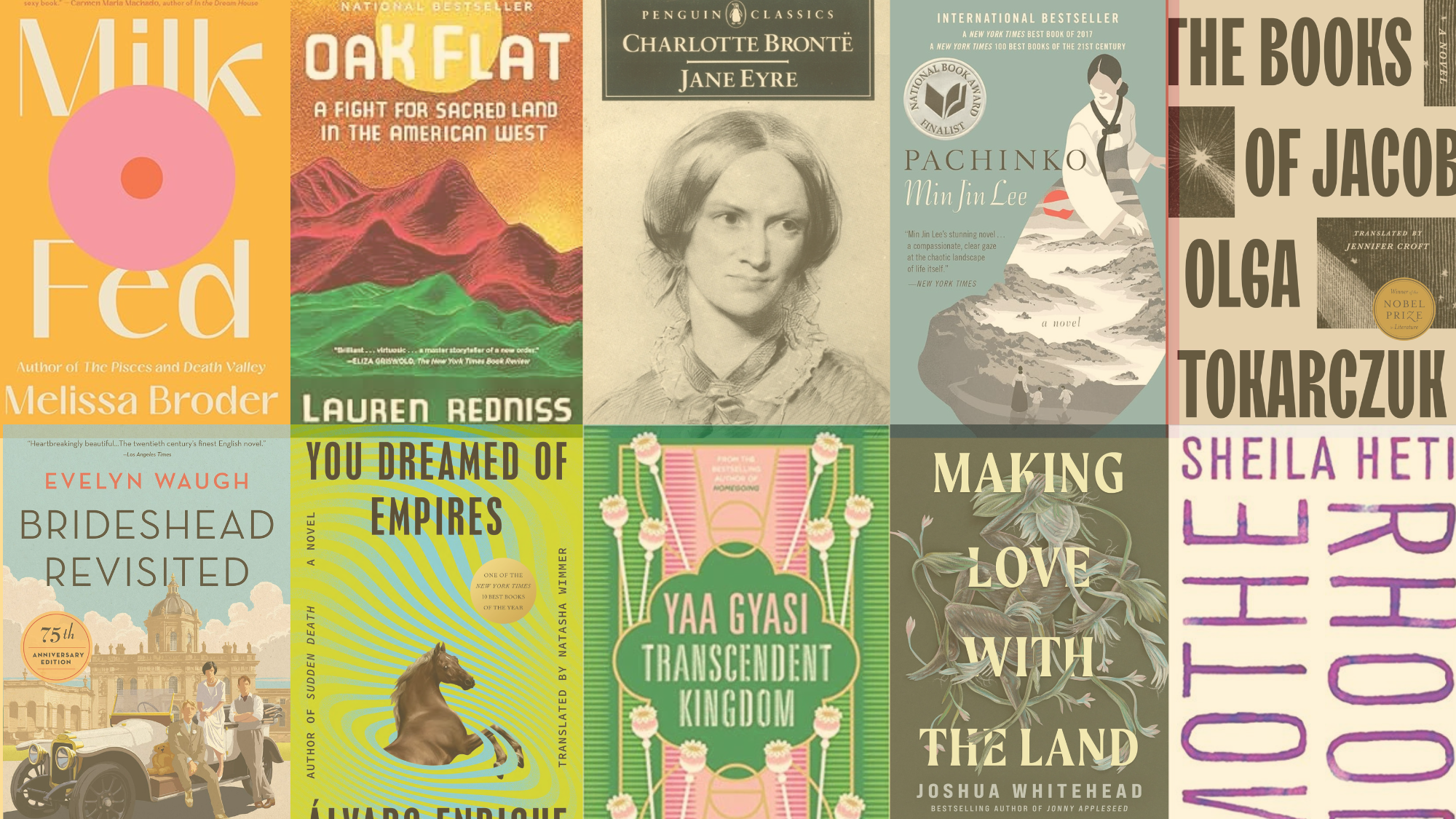
As Niv begins their hiatus, we are all in need of some good books and I am thrilled to share some of my favourite books to get us through this Niv drought—and just in time for summer! As a lifelong reader, narrowing my all time favourite books to just 10 was tough, but I focused on books that made a strong impact on me long after I finished them, as well as titles that span a wide range of genres, time periods, and backgrounds. Enjoy the long, sunny days ahead by laying out with one of these gems (presented in no particular order).
Milk Fed by Melissa Broder
It’s no secret that I’m a big fan of Melissa Broder (I raved about her novel Death Valley in my best books of 2023 round up), and while I have been a devoted fan going back to her first novel The Pisces, Milk Fed is the one that turned my infatuation into a longterm love. Milk Fed features Rachel, a secular Jewish woman who falls for Miriam, an Orthodox woman working at her family’s frozen yogurt shop. Through this relationship, as well as some trippy dream sequences—like a human-sized dancing loaf of challah and hallucinations of Rabbi Judah Loew ben Bezalel—Rachel explores her eating disorder, her issues with her mother, her relationship with Judaism, and her queerness. I view Rachel’s journey as a queer Jewish journey to self-love and acceptance. There’s a lot going on in this book, but if these themes resonate, I recommend you give it a shot.
Oak Flat by Lauren Redniss
Oak Flat is an illustrated, well-researched look at the Native American Western Apache’s fight for Oak Flat, their religious site in Arizona. The book examines how capitalism seeks to damage Indigenous rights throughout the country, the mining rights that have been fought in this area for decades, and the religious importance of the site to the Apache. The story is told through the perspective of the Nosie family, who have spent years of their life fighting for their freedom of religion on this issue. This book completely shaped how I see Indigenous rights and how Indigenous communities must continue to fight for their rights. As a Jewish person, it reminded me how important it is that we defend other religions and cultures when their right to practice is threatened. While the U.S. Supreme Court declined to hear the case last year, the fight for Oak Flat continues, but time is running out.
Jane Eyre by Charlotte Brontë
While the book is a well known classic, anyone who hasn’t read this book is in for a treat. Jane is an orphan in 1840s England who must find her way in the world without the support of family. She faces tremendous loss before taking a job as a governess at Thornfield Hall, owned by the broody Mr. Rochester. While this book is viewed as a classic romance novel, it is famously known for the independence of its protagonist. Her staunch morality and belief in her self-worth made this incredibly influential for me as an 18-year-old, and it has remained so as I’ve gotten older. There are valid criticisms of this novel, largely the dismissal of Mr. Rochester’s first wife, and so I highly recommend pairing Jane Eyre with the post-colonial prequel novel Wide Sargasso Sea by Jean Rhys, to help interrogate those critiques. However, despite its limited,1840s English perspective, it remains a classic, and features an empathetic protagonist who can be admired for her strength.
Pachinko by Min Jin Lee
If you’re looking for a sprawling epic to devour on a summer vacation, this is a good option. Pachinko follows a family from 1910s Korea through the 20th century to 1980s New York, featuring a wide cast of characters. It begins in Korea right on the brink of Japanese annexation, when a woman named Sunja gets pregnant out of wedlock from her abusive lover Hansu. After she confesses to one of her family’s lodgers, Isak, that she’s pregnant, the infirm Christian minister marries her, enabling her to go to Japan to live with his family. The rest of the novel traces the impact of this decision, from the way Koreans are treated in Japan to the struggle of being an immigrant in Korea, and later the United States. I learned so much about Japanese colonialism, something I didn’t learn much about in school or university. Pachinko is a moving depiction of family dynamics and the impact one decision can have on countless future generations.
The Books of Jacob by Olga Tokarczuk, translated by Jennifer Croft
The Books of Jacob won Olga Tokarczuk the Nobel Prize in Literature. It’s a thousand page exploration of 18th century Europe, mostly in what is now Poland. It is told through the eyes of many characters who meet the titular Jacob Frank. Frank, a real historical figure, was a Jewish man who claimed to be the messiah, spawning his own religion later called Frankism, which actually became closely aligned with Catholicism. Frank travelled throughout Europe and the Ottoman Empire spreading his religion and making allies (and enemies), with both Jewish and non-Jewish followers. Tokarczuk is Polish, notably not Jewish, and has made her career in writing about everyday people, often with a feminist bent. The Books of Jacob, with its sweeping and heavily researched historical context, didn’t seem to be in Tokarczuk’s wheelhouse at first. The real power of this novel, and the reason Tokarczuk wanted to write it, was to show that Poland has always been a richly multicultural society, with centuries of Jewish history as well as ample trade and communication with other nations and empires, including the Ottoman Empire. The far-right party in Poland did not like Tokarczuk’s book, and he ended up receiving death threats needing round the clock security protection. Today, it’s important to remember that history isn’t as far back in the past as we might think. Tokarczuk uncovered an almost forgotten aspect of European history, and reminded us that humans have always shared thoughts, ideas, and patterns of movement.
Brideshead Revisited by Evelyn Waugh
This is an underrated classic, written in the 1940s. It follows a young man, Charles Ryderm and his friends, siblings Sebastian and Julia Flyte, from Oxford to World War II. Sebastian and Charles become fast friends at Oxford, and Charles envies Sebastian’s wealth and status in the aristocracy, while also being curious about his family’s Catholicism. There remains a debate about whether their relationship is platonic or romantic, but at the very least, it is absolutely homoerotic. Sebastian’s heavy drinking and depression keeps getting worse, and Charles is alienated from the family for many years, eventually reconnecting and briefly having a relationship with Sebastian’s sister Julia. This book is less about what happens, and more about how it is written. The prose is ornate, with beautifully descriptive passages and evocative scenes that still linger in my mind years after my last re-read. It is ostensibly a book about Catholicism and class, but to me it is a book about youth, those vibrant days in your 20s that feel they will go on forever, and what it means to look back at them when they are long past. Waugh’s prose is indulgent, and in my opinion, doesn’t get the flowers it deserves.
You Dreamed of Empires by Álvaro Enrigue
While I already wrote about this book in my Best Books of 2024 article for Niv, its impact on me has remained over the years, and I’ve given copies to friends ahead of their trips to Mexico City. Prolific Mexican author Álvaro Enrigue’s irreverent and creative reimagining of Cortes’s conquest of Moctezuma’s empire in modern day Mexico City is trippy but well-researched and grounded in reality. The ending is satisfyingly anti-colonialist but also devastating because it exposes what could’ve been. The power of this book rests in the slow dismantling of the Spanish; the defiance of hegemonic power is subtle but effective. With a sprawling and diverse cast, Enrigue is able to showcase a range of perspectives on Spanish colonialism in Mexico, as well as the many fates of people during that period.
Transcendent Kingdom by Yaa Gyasi
The second novel by popular Ghanaian-American author Yaa Gyasi, Transcendent Kingdom follows Gifty, the daughter of Ghanaian immigrants as she gets her Ph.D. in neuroscience at Stanford while helping her mother deal with her debilitating depression. Throughout the novel, we see why Gifty’s mother is so depressed, as her husband suddenly leaves for Ghana and she experiences the loss of a child. Throughout the book, Gifty is also struggling with her Christianity. I related to Gifty wrestling with her faith, and what it means to be religious in an environment where it’s viewed as an anomaly. It’s a moving look at a family that has been dealt a difficult hand, with very human characters and a sympathetic struggle to keep going.
Making Love with the Land by Joshua Whitehead
Throughout this genre-bending book, filled with essays in various formats, Whitehead explores his relationship with the Canadian prairie, as well as what it means to be Indigenous in the modern world while maintaining a relationship with the natural world. Whitehead also discusses the connection between faith and place, his experiences with grief, what it means to be queer and Indigenous, and the struggles he’s had finding his identity and maintaining relationships throughout his life. Some parts of the book are written in English, while others are in Cree, and Whitehead plays with language in the way only a poet could. This book reminds me of the hardest parts of being human, which are so often also the best.
Motherhood by Sheila Heti
Autofiction is not for everyone, but Sheila Heti does it exceptionally, including in this novel. Motherhood is about an unnamed female narrator, based on Heti, in her 30s who is grappling with the decision on whether or not to have children. The narrator is unreliable at times, but in the way that we are all often unreliable when we filter our thoughts and decisions through our own brains. Through this narrator, Heti explores her complicated relationship with motherhood, including her family history, her struggles with her body, and the pressures on Jewish women to have children. Torah metaphors, particularly that of Jacob wrestling with the angel, and the literary device of I Ching, a Chinese divination tool, colour the book’s pages. I Ching helps our narrator as she weighs her options about motherhood. It’s an honest, unflinching, occasionally hard to witness examination of modern women and the pressures society puts on them to have children.
As Niv begins their hiatus, we are all in need of some good books and I am thrilled to share some of my favourite books to get us through this Niv drought—and just in time for summer! As a lifelong reader, narrowing my all time favourite books to just 10 was tough, but I focused on books that made a strong impact on me long after I finished them, as well as titles that span a wide range of genres, time periods, and backgrounds. Enjoy the long, sunny days ahead by laying out with one of these gems (presented in no particular order).
Milk Fed by Melissa Broder
It’s no secret that I’m a big fan of Melissa Broder (I raved about her novel Death Valley in my best books of 2023 round up), and while I have been a devoted fan going back to her first novel The Pisces, Milk Fed is the one that turned my infatuation into a longterm love. Milk Fed features Rachel, a secular Jewish woman who falls for Miriam, an Orthodox woman working at her family’s frozen yogurt shop. Through this relationship, as well as some trippy dream sequences—like a human-sized dancing loaf of challah and hallucinations of Rabbi Judah Loew ben Bezalel—Rachel explores her eating disorder, her issues with her mother, her relationship with Judaism, and her queerness. I view Rachel’s journey as a queer Jewish journey to self-love and acceptance. There’s a lot going on in this book, but if these themes resonate, I recommend you give it a shot.
Oak Flat by Lauren Redniss
Oak Flat is an illustrated, well-researched look at the Native American Western Apache’s fight for Oak Flat, their religious site in Arizona. The book examines how capitalism seeks to damage Indigenous rights throughout the country, the mining rights that have been fought in this area for decades, and the religious importance of the site to the Apache. The story is told through the perspective of the Nosie family, who have spent years of their life fighting for their freedom of religion on this issue. This book completely shaped how I see Indigenous rights and how Indigenous communities must continue to fight for their rights. As a Jewish person, it reminded me how important it is that we defend other religions and cultures when their right to practice is threatened. While the U.S. Supreme Court declined to hear the case last year, the fight for Oak Flat continues, but time is running out.
Jane Eyre by Charlotte Brontë
While the book is a well known classic, anyone who hasn’t read this book is in for a treat. Jane is an orphan in 1840s England who must find her way in the world without the support of family. She faces tremendous loss before taking a job as a governess at Thornfield Hall, owned by the broody Mr. Rochester. While this book is viewed as a classic romance novel, it is famously known for the independence of its protagonist. Her staunch morality and belief in her self-worth made this incredibly influential for me as an 18-year-old, and it has remained so as I’ve gotten older. There are valid criticisms of this novel, largely the dismissal of Mr. Rochester’s first wife, and so I highly recommend pairing Jane Eyre with the post-colonial prequel novel Wide Sargasso Sea by Jean Rhys, to help interrogate those critiques. However, despite its limited,1840s English perspective, it remains a classic, and features an empathetic protagonist who can be admired for her strength.
Pachinko by Min Jin Lee
If you’re looking for a sprawling epic to devour on a summer vacation, this is a good option. Pachinko follows a family from 1910s Korea through the 20th century to 1980s New York, featuring a wide cast of characters. It begins in Korea right on the brink of Japanese annexation, when a woman named Sunja gets pregnant out of wedlock from her abusive lover Hansu. After she confesses to one of her family’s lodgers, Isak, that she’s pregnant, the infirm Christian minister marries her, enabling her to go to Japan to live with his family. The rest of the novel traces the impact of this decision, from the way Koreans are treated in Japan to the struggle of being an immigrant in Korea, and later the United States. I learned so much about Japanese colonialism, something I didn’t learn much about in school or university. Pachinko is a moving depiction of family dynamics and the impact one decision can have on countless future generations.
The Books of Jacob by Olga Tokarczuk, translated by Jennifer Croft
The Books of Jacob won Olga Tokarczuk the Nobel Prize in Literature. It’s a thousand page exploration of 18th century Europe, mostly in what is now Poland. It is told through the eyes of many characters who meet the titular Jacob Frank. Frank, a real historical figure, was a Jewish man who claimed to be the messiah, spawning his own religion later called Frankism, which actually became closely aligned with Catholicism. Frank travelled throughout Europe and the Ottoman Empire spreading his religion and making allies (and enemies), with both Jewish and non-Jewish followers. Tokarczuk is Polish, notably not Jewish, and has made her career in writing about everyday people, often with a feminist bent. The Books of Jacob, with its sweeping and heavily researched historical context, didn’t seem to be in Tokarczuk’s wheelhouse at first. The real power of this novel, and the reason Tokarczuk wanted to write it, was to show that Poland has always been a richly multicultural society, with centuries of Jewish history as well as ample trade and communication with other nations and empires, including the Ottoman Empire. The far-right party in Poland did not like Tokarczuk’s book, and he ended up receiving death threats needing round the clock security protection. Today, it’s important to remember that history isn’t as far back in the past as we might think. Tokarczuk uncovered an almost forgotten aspect of European history, and reminded us that humans have always shared thoughts, ideas, and patterns of movement.
Brideshead Revisited by Evelyn Waugh
This is an underrated classic, written in the 1940s. It follows a young man, Charles Ryderm and his friends, siblings Sebastian and Julia Flyte, from Oxford to World War II. Sebastian and Charles become fast friends at Oxford, and Charles envies Sebastian’s wealth and status in the aristocracy, while also being curious about his family’s Catholicism. There remains a debate about whether their relationship is platonic or romantic, but at the very least, it is absolutely homoerotic. Sebastian’s heavy drinking and depression keeps getting worse, and Charles is alienated from the family for many years, eventually reconnecting and briefly having a relationship with Sebastian’s sister Julia. This book is less about what happens, and more about how it is written. The prose is ornate, with beautifully descriptive passages and evocative scenes that still linger in my mind years after my last re-read. It is ostensibly a book about Catholicism and class, but to me it is a book about youth, those vibrant days in your 20s that feel they will go on forever, and what it means to look back at them when they are long past. Waugh’s prose is indulgent, and in my opinion, doesn’t get the flowers it deserves.
You Dreamed of Empires by Álvaro Enrigue
While I already wrote about this book in my Best Books of 2024 article for Niv, its impact on me has remained over the years, and I’ve given copies to friends ahead of their trips to Mexico City. Prolific Mexican author Álvaro Enrigue’s irreverent and creative reimagining of Cortes’s conquest of Moctezuma’s empire in modern day Mexico City is trippy but well-researched and grounded in reality. The ending is satisfyingly anti-colonialist but also devastating because it exposes what could’ve been. The power of this book rests in the slow dismantling of the Spanish; the defiance of hegemonic power is subtle but effective. With a sprawling and diverse cast, Enrigue is able to showcase a range of perspectives on Spanish colonialism in Mexico, as well as the many fates of people during that period.
Transcendent Kingdom by Yaa Gyasi
The second novel by popular Ghanaian-American author Yaa Gyasi, Transcendent Kingdom follows Gifty, the daughter of Ghanaian immigrants as she gets her Ph.D. in neuroscience at Stanford while helping her mother deal with her debilitating depression. Throughout the novel, we see why Gifty’s mother is so depressed, as her husband suddenly leaves for Ghana and she experiences the loss of a child. Throughout the book, Gifty is also struggling with her Christianity. I related to Gifty wrestling with her faith, and what it means to be religious in an environment where it’s viewed as an anomaly. It’s a moving look at a family that has been dealt a difficult hand, with very human characters and a sympathetic struggle to keep going.
Making Love with the Land by Joshua Whitehead
Throughout this genre-bending book, filled with essays in various formats, Whitehead explores his relationship with the Canadian prairie, as well as what it means to be Indigenous in the modern world while maintaining a relationship with the natural world. Whitehead also discusses the connection between faith and place, his experiences with grief, what it means to be queer and Indigenous, and the struggles he’s had finding his identity and maintaining relationships throughout his life. Some parts of the book are written in English, while others are in Cree, and Whitehead plays with language in the way only a poet could. This book reminds me of the hardest parts of being human, which are so often also the best.
Motherhood by Sheila Heti
Autofiction is not for everyone, but Sheila Heti does it exceptionally, including in this novel. Motherhood is about an unnamed female narrator, based on Heti, in her 30s who is grappling with the decision on whether or not to have children. The narrator is unreliable at times, but in the way that we are all often unreliable when we filter our thoughts and decisions through our own brains. Through this narrator, Heti explores her complicated relationship with motherhood, including her family history, her struggles with her body, and the pressures on Jewish women to have children. Torah metaphors, particularly that of Jacob wrestling with the angel, and the literary device of I Ching, a Chinese divination tool, colour the book’s pages. I Ching helps our narrator as she weighs her options about motherhood. It’s an honest, unflinching, occasionally hard to witness examination of modern women and the pressures society puts on them to have children.